
Climate Change Is Not Gender Neutral
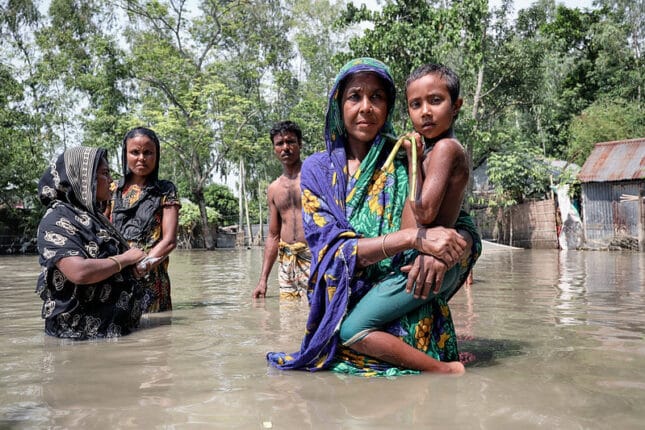
Climate change is often spoken about in the language of numbers like degrees rising, coastlines receding, rainfall patterns shifting. It is framed as an environmental crisis, an economic risk, a geopolitical stress test. Rarely is it described for what it also is i.e. a crisis that deepens inequality and existing hierarchies while disproportionately punishes those who already live on the margins, chiefly, women and girls.
The idea that climate change affects everyone equally is comforting, but a lie. Like every major global disruption, its consequences are filtered through social structures like poverty, power and gender. In many parts of the world, particularly the Global South, the climate crisis is accelerating gender-based discrimination in ways that are both visible and insidiously quiet.
In rural communities across South Asia and Sub-Saharan Africa, women are still primarily responsible for securing water, food, and fuel for their families. As droughts lengthen and water sources dry up, this responsibility does not disappear. Instead, it becomes heavier. Girls walk farther to fetch water, often at the cost of their education. Women spend hours collecting firewood from increasingly distant forests, exposing themselves to harassment and violence. Climate stress turns daily survival into a longer, riskier journey, one that is disproportionately borne by women.
Food insecurity follows a similar pattern. When crops fail or livestock die, women often eat last and least. Malnutrition among women and girls rises during climate-induced famines, even when food is technically available. These are not accidents of nature; they are reflections of social norms that already place women’s needs lower on the hierarchy of importance. Climate change does not create these norms, however, it does weaponize them.
The link between climate disasters and gender-based violence is particularly stark. Studies have shown that rates of domestic violence, child marriage, and sexual exploitation increase in the aftermath of floods, cyclones, and displacement. When families lose livelihoods, girls are pulled out of school and married off earlier as an economic coping mechanism. When displacement camps are overcrowded and under-policed, women face higher risks of assault. Climate emergencies fracture social safety nets, and women pay the price in silence.
Yet much of this suffering remains invisible in global climate discourse. International climate negotiations are dominated by men, conducted in elite spaces far removed from the lived realities of those most affected. Policies focus on emissions targets and technological solutions, while failing to account for how adaptation and mitigation strategies impact different genders differently. A relocation plan that ignores caregiving responsibilities will trap women in deeper precarity.
Even climate ‘solutions’ can reproduce inequality if gender is treated as an afterthought. Large-scale renewable energy projects have displaced communities without consultation, pushing women further from decision-making and economic opportunity. Carbon offset schemes have restricted access to land that women depend on for subsistence farming. Without intentional inclusion, the green transition risks becoming yet another arena where men benefit first and women are expected to adjust.
There is also a moral contradiction at the heart of the climate crisis that deserves scrutiny. The countries most responsible for historic emissions are not the ones experiencing the worst impacts. And within the countries that are most vulnerable, it is women, especially poor, rural, and Indigenous women, who bear the brunt. Climate injustice is layered, and gender is one of its sharpest bits.
But women are not only victims in this story. Across the world, they are also frontline responders, organizers, and stewards of sustainable practices. From community-led water management to climate-resilient farming, women are already leading adaptation efforts, often without recognition or resources. Their exclusion from formal decision-making is not just unjust; it is inefficient. Ignoring women’s knowledge weakens our collective ability to respond to a crisis that demands every available insight.
What would it mean to take gender seriously in climate policy? It would mean collecting gender-disaggregated data and actually using it. It would mean ensuring women’s representation not as a symbolic checkbox, but as a presence in climate negotiations, local councils, and funding mechanisms. It would mean recognizing unpaid care work as part of climate resilience, and designing policies that reduce women’s burdens.
Most importantly, it would require a shift in how we frame the crisis itself. Climate change is not only an environmental emergency; it is a social one. It is a test of whose lives are deemed expendable, whose labour is taken for granted, and whose suffering is normalized as collateral damage.
If climate justice does not include gender justice, it is not justice at all. And if our response to the climate crisis continues to ignore the realities of women’s lives, we will not only fail half the world, we will fail the planet itself.
The climate is changing. The question is whether our moral imagination will change with it.
Fatima Hassan is a freelance journalist and the co-founder & Multimedia Editor of Echoes Media, dedicated to crafting impactful stories that resonate with diverse audiences. A journalism graduate of Northwestern University, Fatima combines analytical rigor with creative storytelling to explore complex issues and amplify unheard voices.
Member discussion