
In the Shadow of Conflict: Violence, Resistance, and the Socio-Cultural Landscape of Kashmiri Women
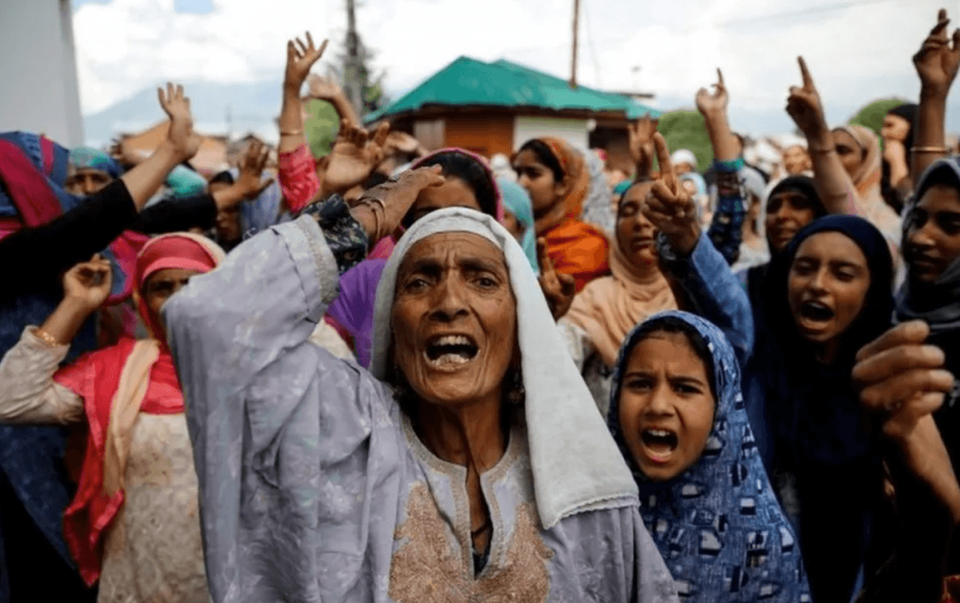
The first thing many women in Kashmir learn about conflict is not found in history books. It is learned through waiting.
A mother waiting for a son who disappeared. A wife waiting for a husband who never returned. A child waiting for a mother who left home one morning and never came back.
For decades, conflict in Kashmir has been measured through numbers– deaths, disappearances, arrests, and statistics. But behind every number exists a personal geography of grief: a kitchen where a woman last cooked a meal, a doorway where footsteps stopped arriving, a courtroom where families continue asking unanswered questions.
Among these stories are women whose lives became inseparable from Kashmir’s unresolved conflicts– women who survived violence, carried memories of loss, and continued searching for justice.
“How to marry a Kashmiri woman” emerged as one of the highest searched queries in Search Engine in the aftermath of the abrogation of Article 370 in 2019, revealing an unsettling shift in how an entire identity was being framed in digital space. What might appear as a simple search phrase instead exposed a deeper gaze which penetrates the body, one that reduced Kashmiri women to objects of curiosity, fantasy and possession rather than individuals with histories, voices, and autonomy. Not only are Kashmiri women fetishized, but their bodies are also weaponized as symbols of power, control and conquest. A study in 2005 conducted by Me’decins Sans Frontiers declares Kashmiri women to be the worst sufferers of sexual violence globally. Since the beginning of the armed struggle for freedom in Kashmir, women have routinely been victims of sexual violence.
Across conflict zones, the stories of women often remain among the least documented yet most deeply scarred. Terms such as half-widows—women whose husbands disappeared, leaving them suspended between hope and mourning—and command marriages, unions shaped by coercion, fear, and the pressures of conflict, reveal the unique burdens women bear during prolonged crises. Where disappearances, displacement, and violence become part of daily life, they reshape not only individual destinies but entire communities. Today, as concerns over violence, disappearances, and human suffering continue to surface in places like Kashmir and Rawalakot, these narratives demand renewed attention.
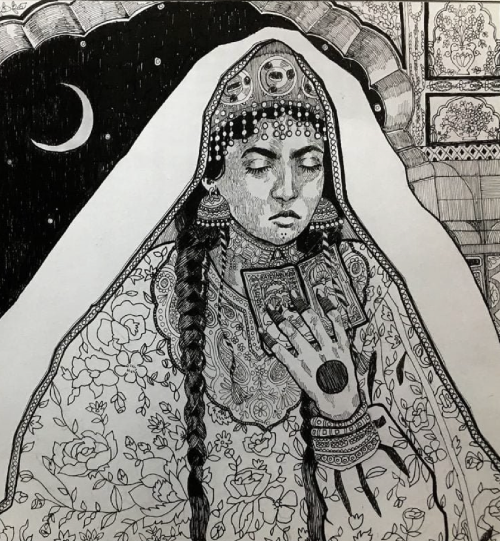
These realities are not new, they echo through history, literature, and memory. The poetry and symbolism of sixteenth century Kashmiri poetess Habba Khatoon from Pampore reflected the grief, separation, and emotional landscape of her time.
She became, in many ways, a cultural bridge between history, memory, and my growing attempt to understand what has long been unfolding in Kashmir. Yusuf Shah Chak, the king of Kashmir, spotted her in the fields one day. Legend has it that he fell in love with the beauty of her voice and richness of her rhyme. Mughal emperor Akbar unable to conquer Kashmir through war and now resorted to tactics of cozenage, summoned Yusuf Shah Chak to Delhi
Upon reaching the Mughal court, Yusuf Shah was flung into prison, never to see the light of day again, and never to see his beloved Habba again.
For the next of her years, Habba pined away in an abode next to the Jhelum, where she was finally laid to rest.
There exists little documentation of the story of Habba Khatun and Yousuf Shah Chak, yet this folklore has been passed down for generations.For many Kashmiri women, Habba Khatoon is more than a poetess remembered in history books. She is a reflection of struggle, longing and resilience. Trapped in an unhappy marriage and later separated from Yusuf Shah, she transformed personal grief into poetry. Her wandering through valleys and mountains became inseparable from Kashmir itself
Yet beyond cultural memory lies something harder to articulate: a silence that has learned to survive. It does not begin with statistics from Crime records; it begins with absence. In Kashmir, that absence sits inside ordinary life, from a woman preparing tea, a daughter studying for exams, a mother waiting for footsteps that never return. Then, without warning, life fractures. That kitchen becomes a site of violence, precise to say a battlefield. A home becomes a space of fear. A body becomes a war spot.
Among these ruptured lives is the story of Haneefa Begum Wani of Kreeri, Baramulla documented in the book of Freny Manecksha: Behold I shine which reports narratives of Kashmir women and children).
In the summer of 2010, during a 35-day curfew in Kashmir, Haneefa stepped out of her home.
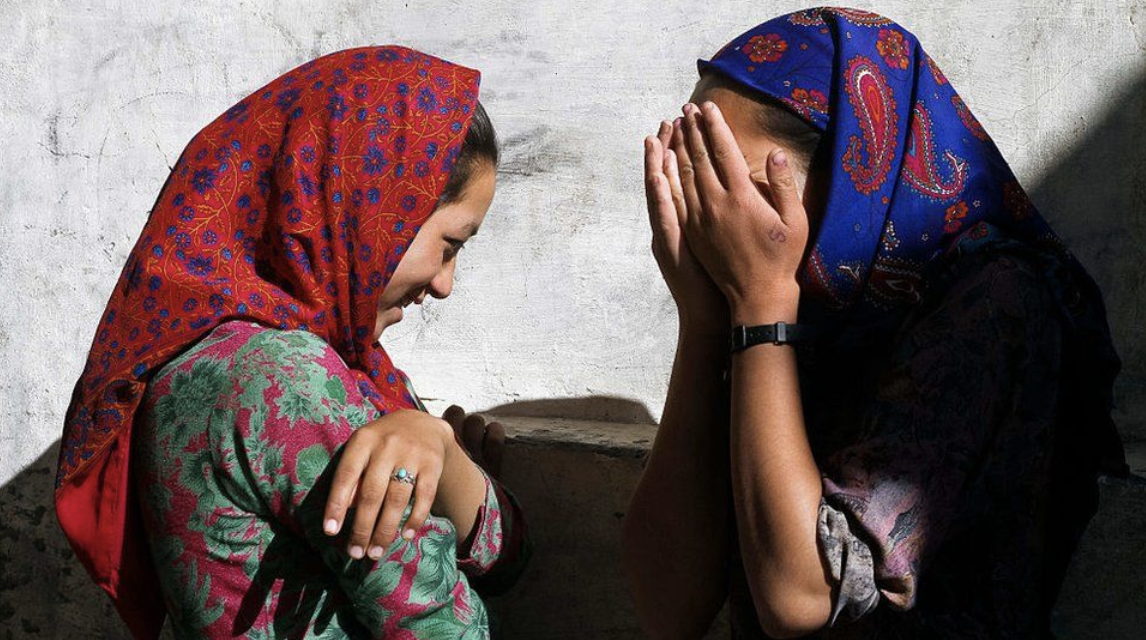
According to her family, Haneefa was not a protestor that day, she was a mother in distress.Moments later, however, the situation changed, when her brother narrates that two CPRF personnel shot her.
He further alleged that after she fell, attempts were made to drag her injured body before locals rushed out after hearing gunfireA medical report later confirmed that bullets struck her seventh dorsal vertebra, leaving her permanently paralyzed.Despite months of struggle, Haneefa eventually succumbed to her injuries.
The mother’s love which broke the curfew to seek medical help is now nowhere for little Humaira, Haneefa’s eleven year old daughter.
The abiding image Freny carries of that visit is of Humaira— her head bowed, sitting in the garden. She had borne witness to her mother being gunned down, suffering and then dying, and was now being provided for by Haneefa’s ageing parents and brothers.
What emerges is not a singular identity, but multiplicity. There is no singular “Kashmiri woman.”
There are students, journalists, mothers, activists, lawyers, and survivors. Women navigating checkpoints on their way to work. Women standing in courtrooms demanding justice. Women marching through streets despite risk. Women carrying invisible wounds of sexual violence while rebuilding lives in remote mountain villages
The questions surrounding women and conflict are not limited to one geography. Across the wider Kashmir region, including areas such as Azad Jammu and Kashmir, communities continue to confront the emotional and social consequences of prolonged political instability.
In Rawalakot and other parts of Azad Jammu and Kashmir, recent public discussions around governance, rights, economic hardship, and political uncertainty have again highlighted how instability affects ordinary lives.
For women, these pressures often remain invisible, carried through unpaid emotional labour, fear for family members, restricted mobility, and the responsibility of holding households together during uncertain times.
While the political contexts differ, the experiences of women across divided regions of Kashmir reveal a shared reality: conflict is not only fought on borders or in political spaces; it enters homes, relationships, and everyday survival.
Their experiences often remain buried beneath the dominant political narrative of conflict.
In October 1992, representatives from Asia Watch and Physicians for Human Rights (PHR) traveled to Kashmir to document rape and other human rights abuses and violations of the laws of war by Indian security forces. They also investigated incidents of abuse by armed militant groups who have also committed rape and other attacks on civilians. Since the government crackdown against militants in Kashmir began in earnest in January 1990, reports of rape by security personnel have become more frequent. Rape most often occurs during crackdowns, cordon-and-search operations during which men are held for identification in parks or schoolyards while security forces search their homes.
In May 1990, Mubina Gani, a young bride, was allegedly detained and raped by Border Security Force (BSF) personnel while travelling from her wedding ceremony to her husband’s home. Her aunt was also reportedly assaulted during the same incident. Security forces had opened fire on the wedding party, killing one man and injuring several others. While authorities initially claimed that the civilians had been caught in crossfire, a subsequent police inquiry reportedly concluded that the women had indeed been raped. Yet no member of the security forces was prosecuted. Just weeks later, in Sopore another case emerged. Hasina, a 24-year old woman from Jamir Qadeem, alleged that she was raped during a night search operation conducted by BSF personnel following an exchange of fire with militants. Medical examinations documented vaginal bleeding, injuries to her genital area, bite marks and scratches across her body. A police report filed in July 1990 charged members of the BSF with rape. Like so many cases in Kashmir’s history, the allegations entered official records, but justice remained elusive.
Across testimonies and fragmented documentation, patterns of violence repeatedly surface. In Chhanpora, located entirely within Srinagar district in the Union Territory of Jammu and Kashmir, India, Noora, a girl in her teens was allegedly dragged from her kitchen and raped alongside her sister-in-law while minor girls were molested nearby.
Across Bijbehara, Haran, Hyhama, Bihota, Srinagar, and Gurihakhar, survivors and families describe cycles of assault, intimidation, and enforced silence.
Some stories remain alive not because justice was achieved, but because survivors refused to let them disappear.
The suffering of Kashmiri women is frequently underestimated. Their stories are harder to access. Indirect violence– the grief of loss, the burden of displacement, the fear embedded in daily life– rarely leaves visible scars. Yet its psychological and social impact is profound.
The scale of gender-based violence in the region is staggering. Since 1989, conflict has claimed about 100,000 lives, leaving thousands of women widowed. Reported by Mehar Zargar, Dr. Kaiser Hayat, a renowned psychologist in the valley, emphasizes the negative impact of the prolonged conflict in Kashmir on women’s mental health, which in turn also affects their reproductive health and complicates their fertility.
Gynecologist Dr. Nayima Kayser sheds light on the growing fertility challenges in Kashmir, especially among women who experience stress or hormonal imbalance. Shockingly, at least 70% of married Kashmiri women report polycystic ovarian syndrome or other reproductive health issues that hinder childbirth, surpassing the national average of 40%.
Documentation by regional rights groups indicates that more than 11,000 women have suffered molestation or gang-rape, while over 23,000 have been widowed and 107,805 children orphaned.
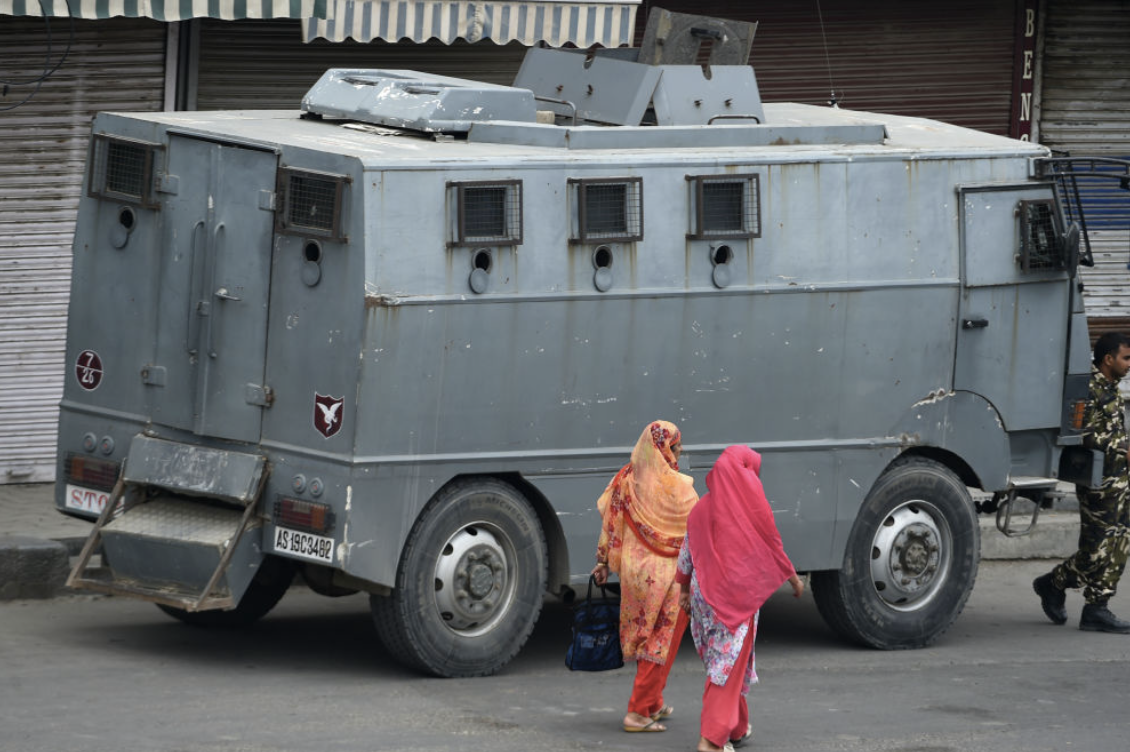
Kashmiri residents walk past a paramilitary armored vehicle at a road block during a lock down in Srinagar on August 30,2019. (TAUSEEF MUSTAFA/AFP via Getty Images)
Half widows have often been victimized by Post Traumatic Stress Disorder (PTSD) in several cases. Beyond economic hardships and emotional trauma, half widows often face intense social stigma. In Kashmiri society, women living alone are frequently viewed with suspicion and subjected to harmful stereotypes. Their efforts to earn a livelihood are scrutinized, while their interactions with lawyers, government officials, or anyone assisting them in their search for justice often become the subject of character assassination and gossips.
It was after the disappearance of her son that Parveena Ahangar, founder of the Association of Parents of Disappeared Persons (APDP) entered a journey that has never ended: a mother searching for her missing son, and a woman transformed into the face of collective resistance
The APDP was founded in 1994 by Ahangar with other family members of victims of enforced and involuntary disappearances in Kashmir.
Reports from the 1990s estimate hundreds of cases of sexual violence, though many were never formally registered due to fear, stigma, and lack of institutional trust. The United Nations and the international rights organizations have repeatedly emphasized underreporting as a major barrier to understanding the full scale of gendered violence in Kashmir.
The disregard for bodily autonomy is also reflected in post-2019 political rhetoric, such as Haryana Chief Minister Lal Khattar’s statement about the path being clear to “bring brides from Kashmir.” Such remarks illustrate the persistent objectification of Kashmiri women in public discourse, particularly in the aftermath of the revocation of Article 370 and Article 35A which also affected property and inheritance rights.
We have become accustomed to the language of violence. A rape becomes a statistic. A disappearance becomes a file. A widow becomes a category. A child orphaned by conflict becomes another number added to a report. Headlines move on. Reports gather dust. The world learns to live with horrors that should have remained unimaginable.
Somewhere in Kashmir, a mother still waits for footsteps that will never return. Somewhere, a daughter still carries the memory of seeing her shot before her eyes.
Somewhere, a woman still visits army camps, police stations, and courtrooms asking the same question she has asked for decades: “Where is my husband?” And somewhere, another survivor remains silent because she already knows that speaking may not bring justice.
Perhaps that is what normalization looks like– not when violence ends, but when society learns to accommodate it. When rape ceases to be a collective outrage and becomes a recurring headline. Where stories of assault are consumed, discussed briefly, and forgotten. When grief becomes routine.
Yet every act of violence described in these pages was experienced by a living person. Every statistic had a name, a face, a family, a future. Haneefa was not a body count. Humaira was not collateral damage. Parveena Ahangar was not merely an activist.They were human beings whose lives were irreversibly altered.
The question, then, is not whether Kashmiri women have suffered. History has already answered that. The question is whether we have become so accustomed to hearing about their suffering that we no longer feel compelled to respond.
Because the day rape sounds something ordinary, the day disappearance becomes expected, and the day injustice feels inevitable is the day violence achieves its final victory–not over bodies, but over conscience itself
Saman Shamim is a Food Technologist, researcher, and journalist whose work explores the intersections of health, society, and human rights. She has written and produced content for documentaries, digital campaigns, and independent media projects, with a particular focus on humanitarian crises, gender justice, migration, public health and marginalized communities. Through her reporting and advocacy oriented storytelling, she seeks to highlight underreported narratives and foster informed dialogue on pressing global issues.
Member discussion