
Pakistan's Diplomatic Rise Is Rooted In Moral Clarity
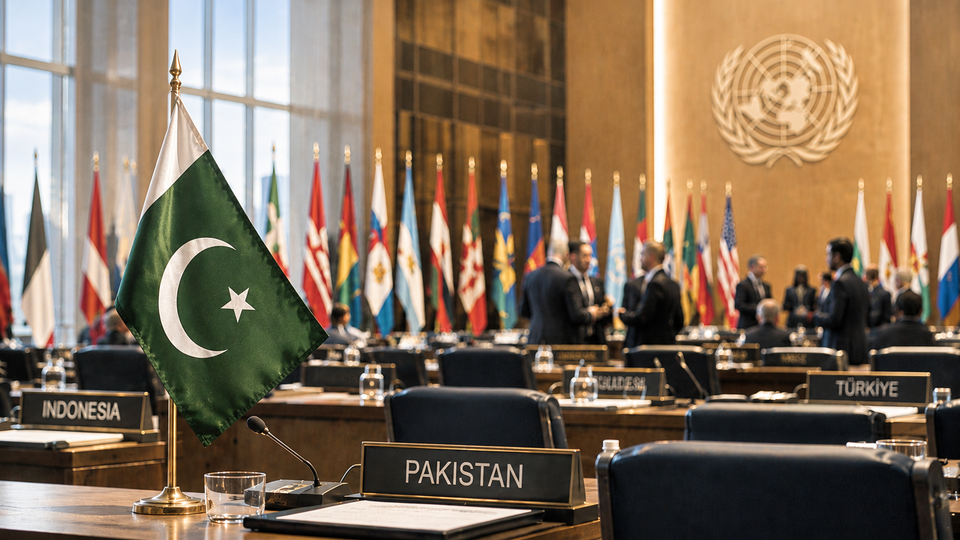
Something has changed in how the world engages with Pakistan.
Regional partners that once approached it with caution now engage it with confidence. Major powers that once bypassed it now consult it. During one of the most dangerous military crises in South Asia in decades, Pakistan emerged not diplomatically isolated but diplomatically heard. That does not happen by accident and it does not happen because of geography or timing alone.
It happens because of trust. And trust, in international relations, is built through one thing: consistent, principled conduct over time.
Pakistan's diplomatic rise is not the result of clever messaging or fortunate circumstance. It is the result of a deliberate shift toward moral clarity, meaning a consistent commitment to stated principles even when doing so carries political or security costs, a decision to remove ambiguity from how the state pursues its interests, particularly on the question of cross-border militancy that had, for decades, defined how the world saw it. That clarity has changed what Pakistan is able to do in the world. The evidence for it is specific, sequential, and increasingly hard to argue with.
A Different World, A Different Pakistan
The international system has shifted in ways that matter for a country like Pakistan. The old unipolar order has given way to something more competitive and more fluid. A multipolar world, a system in which power is shared among several major countries rather than dominated by a single superpower, creates space for middle powers to define themselves on their own terms, to build relationships across blocs, and to be heard in conversations that were once closed to them.
Many countries have benefited from this opening. Pakistan has converted it into something more durable.
The difference is that Pakistan did not simply wait for the world to change. It changed how it conducts itself, and that internal shift is what allowed the external opening to become real influence rather than fleeting opportunity. Moral clarity created the conditions for diplomatic relevance. The multipolar moment provided the stage. Pakistan's conduct earned it the standing to use it.
That shift starts with counterterrorism.
What The National Action Plan Actually Did
The starting point, if you want to understand what has changed, is a school.
On the 16th of December 2014, Taliban militants entered the Army Public School in Peshawar and killed 132 children. It was the kind of violence that changes something in a country, not just in grief, but in resolve. Pakistan launched the National Action Plan, a comprehensive state strategy adopted after the attack to combat terrorism through military operations, legal reforms, financial monitoring, and restrictions on militant organisations. Not a document. A dismantling.
Militant financing networks were disrupted. Organisations were shut down. Military operations, Zarb-e-Azb (a major 2014 military campaign targeting militant strongholds in North Waziristan) and Radd-ul-Fasaad (a nationwide counterterrorism operation launched in 2017 to eliminate residual militant networks), pushed into territory that had operated beyond effective state control for years. Pakistani soldiers died doing it. Pakistani civilians died because of the backlash.
The international community noticed. FATF, the Financial Action Task Force, an international body that monitors countries for money laundering and terrorism financing risks, the global financial watchdog that had placed Pakistan on its grey list, a designation that subjects countries to increased financial scrutiny and can discourage foreign investment, specifically over concerns about militant financing, removed Pakistan from that list in 2022. That is not a political gesture. It is a technical, evidence-based assessment. You do not get off the FATF grey list by making speeches. Pakistan got off it because the evidence met the threshold.
This was moral clarity in its most concrete form. Not a position stated in a press conference but a policy pursued at real cost, verified by an independent international body, and sustained over years. It changed the baseline from which every subsequent diplomatic conversation about Pakistan began. The country that the world had grown used to managing as a risk became, incrementally and verifiably, a country that was managing risk itself.
Kashmir: A Position, Not A Proxy
Pakistan's position on Kashmir has never changed and probably never will: it is disputed territory, the subject of UN Security Council resolutions, passed in 1948 and 1949, that called for a plebiscite, a referendum allowing the people of Kashmir to decide their political future, that was never held. Pakistan does not accept Indian sovereignty over the valley and frames resistance to that sovereignty as legitimate under international law. That position is genuinely contested, India sees it very differently, but it is not without legal grounding.
What has changed is the method of pursuing it.
Where previous chapters of this story involved supporting armed groups operating across the Line of Control, the de facto border dividing Indian-administered and Pakistani-administered Kashmir, recent years have seen Pakistan consistently push for dialogue, multilateral engagement, and international observation. The grievance has remained. The approach to pursuing it has fundamentally shifted.
This distinction is at the heart of why moral clarity matters diplomatically. A country that holds a contested position but pursues it through legitimate channels is treated very differently to one that holds the same position while sponsoring violence. Pakistan has moved clearly into the first category, and that move is what made its arguments about Kashmir receivable in international forums where they were once dismissed outright.
The India Conflict: Moral Clarity Under Pressure
Moral clarity is easy to claim in peacetime. It is tested in crisis.
When India launched Operation Sindoor in May 2025, a cross-border military strike carried out by India following a militant attack, striking targets inside Pakistan following the Pahalgam attack, a militant attack in Indian-administered Kashmir that killed 26 civilians, Pakistan's response reflected the policy discipline it had built over the previous decade. It called for a neutral, third-party investigation, meaning an inquiry conducted by an independent international body such as the United Nations or another mutually agreed institution, not retaliation as a first move. Not escalation. A process.
The major powers, the United States, the Gulf states, and China, did not endorse India's accusations outright. They called for restraint and dialogue.
You do not get that international response unless the world has developed genuine confidence in your conduct.
What sustained that confidence during the crisis was transparency. Pakistan's military spokesperson addressed the public regularly, providing detailed updates about developments on the ground. Casualties were acknowledged. Damage was not hidden. The state did not attempt to present a flawless picture. It shared the reality of the situation as it unfolded, including the costs. That honesty built domestic confidence, and domestic confidence reinforced international credibility.
The domestic response itself became evidence of moral clarity. Journalists and analysts who had spent years scrutinising and criticising the establishment publicly supported Pakistan's conduct during the conflict. That support was not driven by pressure or nationalist sentiment. It was driven by the perception that the state had acted responsibly and communicated honestly. When historically critical, independent voices defend a state voluntarily, on the basis of observable facts rather than loyalty, international observers take notice. It signals that the country's narrative is grounded in reality. Domestic credibility became a direct source of diplomatic strength.
The contrast with the other side was visible. Sections of the Indian media circulated claims about the scale of damage inflicted on Pakistan that independent observers later struggled to verify. One side communicated cautiously and documented what was happening. The perception gap that followed did not go unnoticed among regional partners and analysts. Moral clarity, it turned out, was not just a principle. It was a competitive advantage.
Afghanistan: The Same Standard Applied Westward
If the India conflict demonstrated moral clarity under external pressure, the situation with Afghanistan tested it against Pakistan's own security interests, a harder test by far.
The Tehrik i Taliban Pakistan, commonly known as the TTP, a militant group that primarily targets the Pakistani state and operates separately from the Afghan Taliban, continued to use Afghan soil to launch attacks inside Pakistan, killing civilians and soldiers in significant numbers. The temptation to respond with immediate force was real and the domestic pressure to do so was significant. Pakistan instead chose a path that prioritised process.
It raised the issue with Afghan authorities through diplomatic channels. Repeatedly. It brought in regional partners, Turkey and Qatar, to try to find a diplomatic resolution. That process continued over an extended period, even as attacks persisted and the cost in Pakistani lives mounted.
Only after sustained violence and the repeated failure of that diplomatic process did Pakistan conduct limited cross border military strikes.
The sequencing is the point. Diplomacy first, force as a last resort, with other parties involved throughout. For a country whose critics had long accused it of reaching for asymmetric tools, meaning indirect methods such as proxy groups or irregular warfare used to offset conventional disadvantages, whenever its interests were challenged, that sequencing was a statement of its own. It demonstrated that the standard Pakistan asked others to meet, exhaust legitimate channels before resorting to force, it was prepared to meet itself. Moral clarity applied to an easy situation is not moral clarity. Applied to a painful one, it is.
But the pain in this case was not only strategic. It was moral.
Afghanistan is not a distant adversary. It is a neighbouring Muslim country with deep historical, cultural, and religious ties to Pakistan. For many Pakistanis, the idea of using force across that border carries an instinctive discomfort that does not exist in conflicts elsewhere. The decision to strike was therefore not only a military calculation. It was a moral burden. It required the state to justify to its own people why force had become unavoidable against a country with which it shares faith, history, and geography.
That burden became even heavier when civilian casualties occurred.
In March 2026, a strike on what Pakistan identified as a weapons and drone depot inside a former NATO compound in Kabul, a military installation previously used by international forces during the NATO-led mission in Afghanistan from 2001 to 2021, resulted in catastrophic civilian casualties at an adjacent drug rehabilitation centre. Pakistan did not deny that civilians were harmed. It maintained that the strike hit its intended military target and that secondary explosions from stored ammunition caused the casualties at the clinic, a claim disputed by several independent investigators, including international humanitarian and monitoring organisations, and marked the most severe escalation of the conflict.
There is also an uncomfortable asymmetry that responsible states must acknowledge. Pakistani lives lost to cross border attacks are counted immediately and publicly. Afghan lives lost in retaliatory strikes are often reduced to numbers, reported briefly, and then absorbed into the background of conflict. That imbalance in attention does not reflect the value of those lives. It reflects the proximity of suffering to the societies that experience it. Moral clarity requires recognising that difference without denying the legitimacy of self defence.
What followed matters. Within 48 hours, Pakistan agreed to a ceasefire at the request of Saudi Arabia, Turkey, and Qatar, framing the pause explicitly as a humanitarian gesture in keeping with the spirit of Ramadan and Eid. Pakistan had no conceivable strategic interest in targeting a rehabilitation centre full of patients. The speed of the de escalation, and the humanitarian terms in which it was framed, reflected an awareness that whatever had happened, continuing was not defensible.
Moral clarity does not mean flawless execution. It means being honest about what happened, acknowledging the human cost on all sides, and choosing restraint when escalation serves no legitimate purpose.
Iran: What Neutrality Actually Looks Like
When tensions between the United States and Iran escalated into open conflict, following a period of military strikes and retaliatory actions that raised fears of a wider regional war, Pakistan did something genuinely difficult in a region of pressured alignments: it refused to take a side.
When US and Israeli military action threatened regional stability, Pakistan condemned it. When Iranian retaliatory strikes threatened Gulf partners, Pakistan condemned those too. Condemning both, at a time when every country in the region was being pushed to choose, required the kind of independence that only a state with clear principles can sustain.
But Pakistan did not stop at statements. It kept communication channels open with both Washington and Tehran throughout the crisis, and that sustained contact is what eventually allowed it to bring both sides to the table. Both the United States and Iran publicly acknowledged Pakistan's role in reaching a ceasefire.
That acknowledgment reflects something specific. It is only possible to mediate between deeply distrustful antagonists if neither believes you are secretly aligned with the other. Pakistan earned that position not through any single gesture but through a sustained pattern of conduct that made its principles readable and reliable to opposing actors at the same time.
Taken together across NAP and FATF, Kashmir, the India conflict, Afghanistan, and Iran, the pattern is too consistent to be coincidental. Moral clarity, applied repeatedly across radically different contexts, has produced a new kind of diplomatic standing. That is the argument. And the evidence for it keeps accumulating.
The Stakes Of Getting This Right
Pakistan's diplomatic rise is real. It is rooted in something real. And it matters, not only for Pakistan but for a region where stable, principled state conduct has historically been in short supply.
Recognizing what has driven that rise is not an act of generosity toward Pakistan. It is an act of accuracy. And in a region where misreading intentions has cost thousands of lives, accuracy is not a small thing.
The moral clarity Pakistan has built is consequential. The task now is to complete it, to carry the same standard across the border between foreign policy and domestic governance, and in doing so, to make the argument not just for a more trusted Pakistan in the world, but for a more just Pakistan for the people within it.
Syed Hassaan Ahmad is a strategy and public sector consulting professional whose work has included governance, institutional strategy, and communications engagements across the Middle East and South Asia. His writing explores geopolitics, media, culture, belief systems, and the changing relationship between states, institutions, and people in the modern world. He holds a master’s degree from Imperial College London.
Member discussion