
When Culture Becomes Clickbait: The Hidden Harm Behind Kalasha Representation

As Yorika walked to the Zoshi festival site, she noticed a man pointing his camera at her. When she asked, “Why are you taking pictures without permission?” he offered to pay her. “You people take pictures for money, we will pay you,” he said.
In recent years, these incidents have become common for women in the Kalash Valley. Tourists take pictures without consent and circulate the images widely on social media. In most of these posts, the women are simply dancing at festivals or doing everyday household tasks, yet the content is framed as something sensational. The captions often recycle myths about the community.
“Many people speak for personal gain or online popularity without realizing the harm they cause,” Chitral-based writer and journalist Muhkam Uddin said. “They share pictures and stories that have no connection to reality, just to attract attention or views.”
The Kalasha, or Kalash, are a small indigenous community living in three valleys (Bumburet, Rumbur, and Birir) in the southern part of Chitral in Khyber Pakhtunkhwa province in Pakistan. They are often said to have descended from Alexander the Great’s army or to have migrated from parts of Central Asia. There are many other theories about their origin, but the exact origin remains uncertain.
“The Kalash culture is unique not only in the northern areas of Pakistan but in the entire world,” Muhkam added. He said that the Kalasha history is likely around 3,500 years old.
“In the 10th century, the Kalash ruled all of Chitral,” he said. “But after the spread of Islam in the 13th century, their influence declined. By the 18th and 19th centuries, they were confined to just three valleys.”
According to Muhkam, a 1960 census showed roughly 7,000 Kalasha. Today, fewer than 4,000 remain, with estimates ranging from 3000 to 4,000. “The decline in their population is worrying,” Muhkam said.
Despite decades of hardship and external pressures, the Kalash continue to uphold their rituals and traditions. In recognition of this heritage, UNESCO inscribed Suri Jagek, a traditional Kalasha practice of observing the sun, on the List of Intangible Cultural Heritage in Need of Urgent Safeguarding in 2018.
Their identity is often reduced to physical traits—fair skin, blond hair, and blue eyes—because these features stand out in contrast to surrounding communities. The Kalasha follow a faith and religion with values that differ from those of the dominant beliefs around them. Their physical features, customs, and traditions have made them a subject of fascination and misunderstanding.
Today, the Kalasha face many problems that threaten their culture. Poor road conditions, a lack of healthcare facilities, limited job opportunities, and a shrinking population make everyday life hard for them. Many young Kalasha children move to other cities after completing secondary school because there are no higher education institutes in the valleys. Because of these factors, the culture that was once rooted in these valleys is fading day by day.
“They are under constant pressure from the Muslim majority,” Muhkam said.
Yet despite these pressures, the Kalasha welcome visitors during festivals such as Chilam Joshi, Uchal, and Choimus, inviting people from across Pakistan and beyond to witness their customs and traditions. Unfortunately, this openness is often taken for granted by tourists.
A simple online search for the Kalash Valley reveals countless images and videos of women dancing and celebrating festivals, highlighting their culture, heritage, and customs. These moments are often taken out of context. On social media, these are uploaded with thumbnails and captions that spread myths about the community, such as claims that women are sold or run away during festivals.
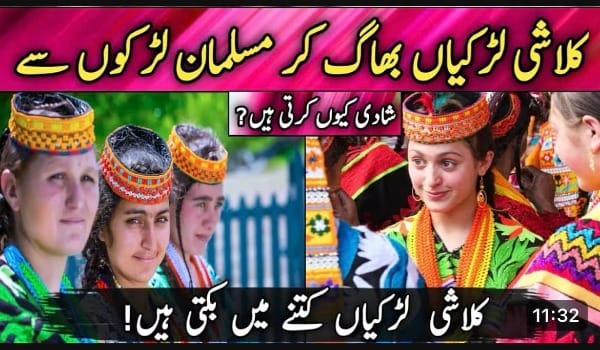
“The Kalash culture is widely publicized through media, and most of the time, what’s shared is inaccurate,” Muhkam explained. “The way their culture, especially marriage customs, is portrayed online is often wrong and disrespectful.”
These pictures and videos fuel a wave of misinformation online. It has now become increasingly common to see tourists filming and uploading clips without consent, under sensationalized titles such as “Kalasha Girls for Sale? Secret of Kalasha Marriage & Traditions,” which have gained millions of views. In reality, these traditions do not involve the sale of women, and most of the claims are baseless and false. Talking about these traditions requires a much deeper understanding of the overall Kalsha’s culture and religion.
Some creators just use these catchy thumbnails with text such as ‘brides market’ and ‘buying and selling of women’ in order to get views. Most of these videos then go on to discuss their culture and traditions, but just scrolling through them creates suspicion about the community.
“I’ve even seen videos on YouTube showing how to ‘buy’ Kalasha girls,” a sociologist and community member, Yorika Taj, said. “Which is completely wrong.”
A review published by the National Institutes of Health (NIH) explains this as the illusory truth effect: repeated exposure to a false claim leads people to believe in misinformation. The constant repetition of these claims influences how the outside world sees the Kalasha.
Much of tourism in the valleys today is driven by viral curiosity. While some visitors arrive to experience the culture and festivals, some visitors come in the hope of meeting the women featured in the viral videos.
“Tourists come here with two different mindsets,” Yorika said. “Some come to enjoy the festival. Others come with the intention of impressing or proposing to the girls.”
In October 2021, an interview with two Kalasha girls went viral, gaining up to 3 million views. Originally posted on YouTube, the video was then widely shared across different social media platforms. In the interview, the girls stated that Kalasha women “run away with whoever they want” and do not get married, but they did not provide full context or accurate details about marriage traditions. Later, these clips were used against the community to further discriminate against them and spread hate online.
“Many young Kalash are active on social media, and some of them often lack full knowledge of their traditions, just as not every Muslim fully understands Islam,” Muhkam said. “Only those with a deep understanding of their religion and customs should represent them online. People should consult Kalash elders, instead of spreading half-truths.”
This web of exploitation offers no protection to the younger Kalash generation, and young girls are often caught in it as well. Zeeshan Khan, a college student and community member, recalled an incident from his childhood:
“I was at the festival’s dance area when I saw some men trying to take pictures with the kids,” he said. “The kids moved away because they were scared. One of the men called a little girl by showing her money. He took her onto his lap and took a picture.”
Zeeshan added that he was too young at the time to know how to respond, but after seeing him, the man quickly put the girl down and walked away.
Most of the content shows women only, because they are an easy target for people and are more vulnerable to exploitation. The Kalasha men, who are equal representatives of the culture, are rarely shown in videos and interviews.
People from diverse backgrounds visit the region year-round and during festivals. According to the Kalash people, some of the local tourists don’t respect them; they invade their privacy, disrespect them, and record them without consent. On the other hand, foreign tourists also visit these places, but they respect the people, their culture, and traditions.
“Pakistani tourists do these kinds of things,” a member of the community, Syed Wali said. “Foreigners are very civilized; if they want to take pictures, they ask for permission first”.
The Kalasha are known for their hospitality. They open their doors and welcome everyone into their houses. But in recent years, the behaviour of some local tourists has made them reluctant to even talk to them. Umair Ali Khan, a resident of Chitral, recalled his visit to the Bumburate valley and his interaction with the Kalash during the summer of 2025.
“I was working on a project about the Kalash culture, and when I approached people for an interview, most of them refused,” Umair said. “ People were hesitant to talk when they saw the camera.”
According to a 2018 article by The News, a man named Aimal Khan was arrested for harassing a group of Kalash women whose video had gone viral. In the same year, based on an article by Dawn, the local police took notice of a tourist who was allegedly following a group of Kalash women and asking them to pose for a photo with him. These aren’t the only cases; dozens of similar incidents occur, but most of them go unreported.
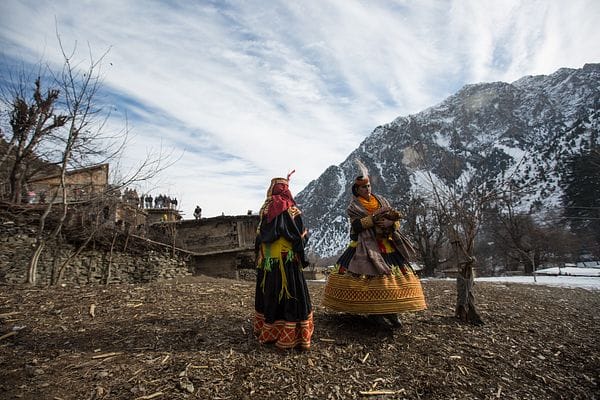
These narratives shared online influence how the Kalasha are seen and treated in real life. Women from the community face objectification and judgment from outsiders who believe the distorted portrayals as true.
“People misunderstand us and our culture because of wrong messages on social media,” a community member, Syed Wali said.
In Pakistan, women’s honor is often questioned, which is why many limit themselves to their families and communities. However, for Kalasha women, this scrutiny is more intense. Due to their distinct cultural and religious values, they are denied societal respect.
“People treat us as if we are dolls or toys,” a community member, Zarmast, said.
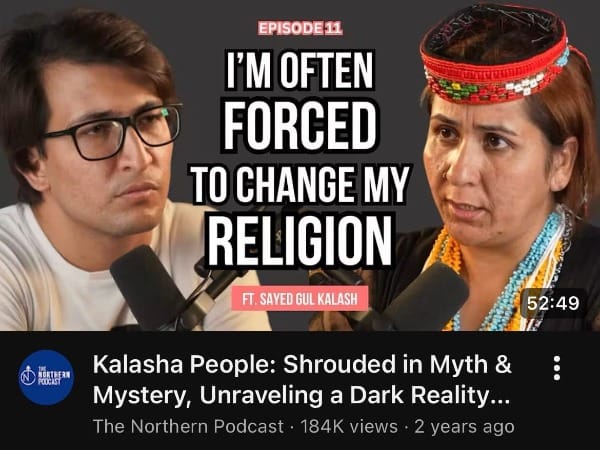
In a November 2023 episode of The Northern Podcast, a well-known Kalasha archaeologist and researcher, Syed Gul Kalash shared:
“When I finished college and was leaving Chitral for university, many people advised me not to tell anyone that ‘you are a Kalash,’ because people don’t like that and they would tease you.”
Based on the narratives shared online, the Kalasha people face significant challenges in celebrating their culture. According to a National Commission of Human Rights Pakistan (NCHR) report, “Kalasha are facing difficulties in celebrating festivals because of the inappropriate behaviour of the tourists. For instance, the festival of Ratnat has not been celebrated for the past 10 years. Similarly, the festival of Rhuzhias, celebrated to punish the King Satan, is only celebrated in Birir after three years.”
The societal pressure, along with socio-economic challenges, could ultimately threaten this unique culture.
“Their culture isn’t extinct yet, but it’s endangered,” Muhkam said.
In Pakistan, the Prevention of Electronic Crimes Act (PECA 2016) provides a legal framework to prevent cybercrimes. According to Dawn, in August 2025, the National Assembly urged the government to ensure strict punishment for individuals involved in unauthorized video recording and cyber-harassment. For Kalasha women, who regularly face digital exploitation, these steps are crucial.
In 2022, The Express Tribune named Chitral among the top destinations for both local and foreign tourists. The Kalasha community has the potential to elevate Pakistan’s tourism by offering a rich blend of history, culture, and landscape. Nowadays, Kalasha women actively work in different fields. These women participate in a variety of jobs, including teaching, owning businesses, and running shops. Additionally, the women make the traditional gowns, caps, jewellery, and other accessories, keeping their traditions alive. Their participation in all aspects of life is important to prevent the culture from fading further.
The Kalasha women are human, just like other women. They are equal citizens of Pakistan, having the same rights and dignity as everyone else. Their voices need to be heard and protected. It’s time people should stop seeing Kalasha women as entertainment and a means to get views.
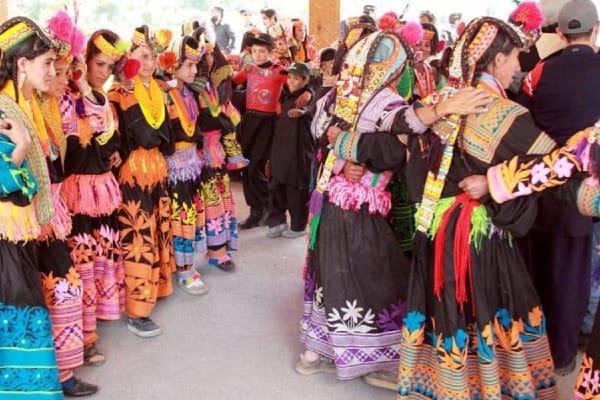
When visiting, seek permission before photographing or filming. If videos or pictures exploit them, report the content. Support and share factually accurate stories and information about the Kalasha, and encourage others to respect their rights and dignity.
Next time you see pictures or videos of them online being exploited, remember they are also humans, not objects for online content and entertainment. What people would never accept for themselves cannot be justified for the Kalasha. Only then can young women like Yorika celebrate their culture without fear of harassment or exploitation. Respect and dignity should never be the cost they pay for tourism that promises ‘prosperity.’
Muhammad Abdullah Farid is an 18 year student from Chitral studying in 12th grade at the Langlands School and College. He has a growing interest in writing and journalism with a focus on issues impacting minorities, people with disabilities and children
Member discussion