
A Son Lost, A Family Broken: The Custodial Killing of Hamdan Baloch
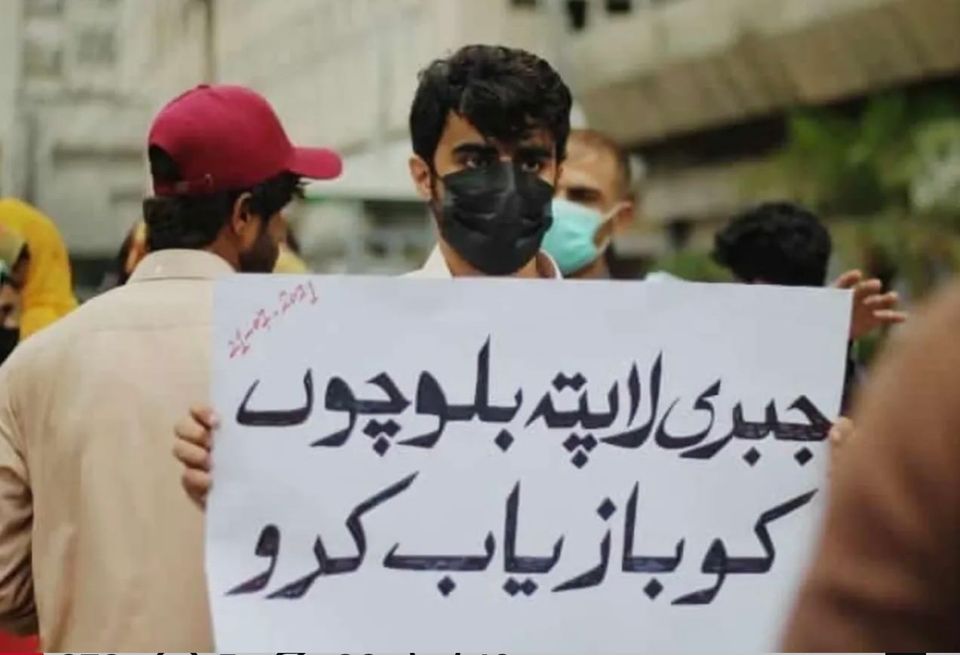
On the afternoon of February 25th 2026, under the scorching heat of Karachi’s Baloch-populated area of Lyari, a somber atmosphere enveloped the crowd gathered at the funeral of 23-year-old Hamdan. His lifeless body, finally claimed by his family after eight harrowing days in the morgue, lay beside his grieving old mother, Jameela.
Surrounded by a sea of Baloch men and women who came to stand in solidarity, the weight of the moment was not lost on anyone. Tears filled every eye as Jameela, in a voice trembling with pain, repeated words that struck at the core of every onlooker. “Firaoon was as ruthless as this,” she said in Balochi, “whenever a male child was born, he was to be killed.” Her voice broke as she added, “This is also the [Fir’awn] Pharaoh-like government, where our children grow, only to be forcibly disappeared, killed, and discarded.”
People of all ages, hearts heavy with grief, held posters and placards bearing the image of Hamdan. As they gathered around his body, chants of “Stop Baloch Genocide” and “Hamdan wants justice” echoed through the air, filling the space with the mournful cries of the crowd. Yet, amid this somber scene, the overwhelming presence of Sindh police and CTD officials forced the family to bury Hamdan within just five minutes, threatening to take his body by force if they did not comply.
Hamdan, a young student from Golimar, a Baloch-populated area of Karachi, was enforcedly disappeared on the morning of December 29, 2025. Around 10 a.m., he left to run a few errands, telling his mother he would be back in just a few minutes.
Those minutes turned into days, but Hamdan never returned. Jameela recalls that for three days after his disappearance, Hamdan's phone remained on. The calls kept ringing for hours, but there was no answer. Even his WhatsApp was still active.
“I sent him a voice note, and it showed as read,” she says. “I told him while crying, ‘Hamdan, you would wake up and fall asleep watching me. I’m here, calling, but you don’t even answer. What’s happened to you, my beloved Hamdan?’”
But there was no response. After the third day, his phone was switched off. Still, Jameela continued to send him several voice notes, hoping for a sign, any sign, that her son was still there.
It wasn’t until January 6, 2026, that the family learned of his fate through social media, when the Counter-Terrorism Department (CTD) held a press conference. In the briefing, the CTD claimed that Hamdan, along with several others, had been arrested in the Raees Goth locality on suspicion of links to a banned militant organization.
An Armed 'Encounter' in Custody?
Hamdan had already appeared in court twice, with a third appearance scheduled for February 18, following the conclusion of his physical remand. But instead of attending court, the family was hit with the heartbreaking news on February 17: Hamdan had been killed in a police ‘encounter.’
On 17 February, DIG CTD claimed that four alleged terrorists were killed during a CTD raid on a house in Latif Shah Town, Karachi. According to the statement, the raid was conducted based on the identification provided by a previously arrested suspect. When security forces surrounded the house, the militants present at the site allegedly opened fire on the personnel. During the exchange, four already arrested suspects were injured due to firing by their own accomplices and later succumbed to their injuries; however, later it became clear one of the individuals killed in the so-called encounter was Hamdan Baloch, who was forcibly disappeared on the 29th of December.
On the day Hamdan failed to return home, his father, Muhammad Ali, and Hamdan’s elder brother visited the Pak Colony police station between December 29 and 31, 2025, only to be refused the filing of an FIR. On January 1, 2026, the family filed a petition in the High Court.
According to Muhammad Ali, Hamdan was presented before the Anti-Terrorism Court (ATC) on January 24 and again on February 12, with his physical remand set to conclude on February 18—51 days after his arrest. After that, he would have been transferred to judicial remand, and the family could have applied for bail. "But they killed my son in custody on the 50th day, just one day before he was to be presented in court," his father said, his voice heavy with grief. He condemned the CTD's claim of an "armed encounter," calling it a mockery. "He was in custody, and they themselves confirmed his arrest," Muhammad Ali added.
"They Didn’t Let Me See Him, Not Even for the Last Time"
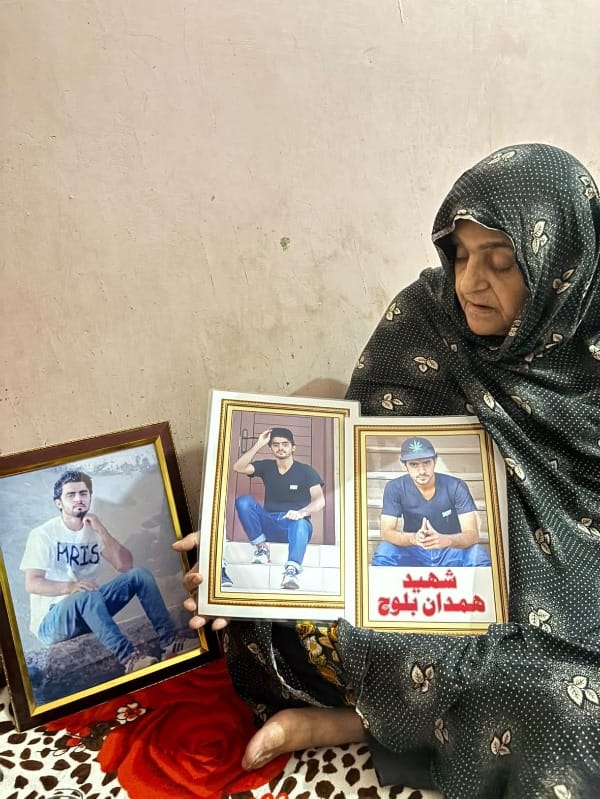
In the narrow, winding streets of Golimar, where only one person can pass at a time, Jameela lives with her family in a small, worn-down room. Wrapped in a black chador, she sits surrounded by women, including her daughters, husband, and sons. Beside her, a picture of Hamdan is displayed with the words "Shaheed Hamdan Baloch" (Martyr Hamdan Baloch) written in Urdu. As tears fall from her eyes, her other son gently tells her, “Amma, I told you not to cry.” In response, she whispers, “Yes, beloved, I won’t cry. Hamdan is a martyr, I won’t cry.” Yet, despite her words, her tears continue to fall, filling the room. Those sitting next to her gently adjust her chador and hair, helping her sit up once again.
“All I know is my beloved son just left home, and he disappeared without a trace. He never came back,” Jameela says, her voice trembling. “What could I do? Nothing. I just sat and counted the days”.
She recalls how their lawyer told them that Hamdan had been held at Karachi's central jail. Before each of his court hearings at the Anti-Terrorism Court (ATC), Jameela would wake up at 5:30 a.m., clutching a few of Hamdan’s clothes and her National Identity Card (CNIC) in her Pandol, the pocket sewed onto Baloch dresses.By 7:00 a.m., she would arrive at the jail, hoping to catch a glimpse of her son.
“I would go so early and sit there for hours, thinking that maybe, just maybe, when they were taking him to the vehicle for court, I would see his face,” she says, her eyes clouded with grief. “But that never happened.”
She recalls asking a police officer each time, “When will Hamdan be taken to court?” The answer was always the same: “Amma, you are wasting your time.”
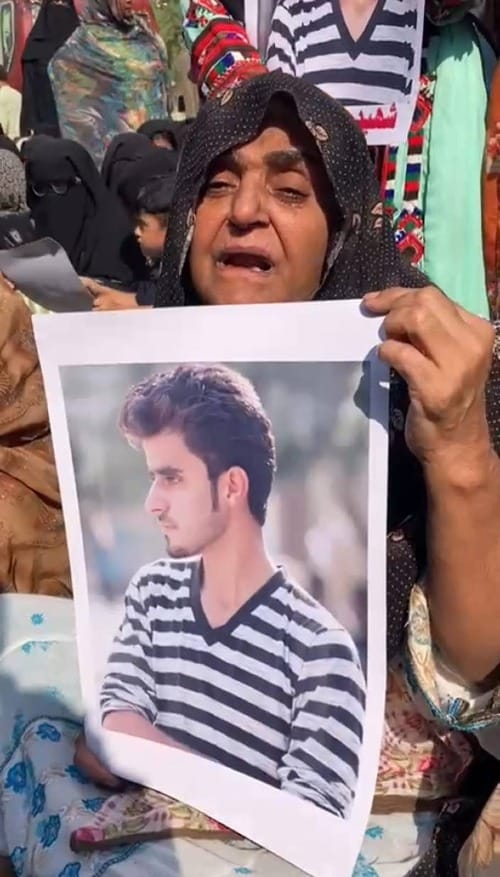
What hurts her the most, she says, is the fact that she never saw him again. “I would see the big police vehicles leaving the station, and I didn’t know if Hamdan was inside them,” she continues. “I would run after them, but the vehicles would disappear. The clothes of Hamdan I held in my hands would fall, and the police officers behind me would laugh. ‘Amma,’ they’d say, ‘those vehicles are too fast—they could have killed you.’And when I asked about Hamdan, they would tell me, ‘He’s been taken away. Go back.’”
Jameela would wait, hoping against hope that after the hearing, she would finally be able to see him, even for a moment. But that, too, never happened.
She shared, “I told one of the policemen, the one who had told me not to come, ‘Please, just let me see him once. I just want to know if he needs water. I want to give him a spoonful of water. I want to see if his beautiful face is still the same after the torture.”
She shared, “I would see those vehicles and scream Hamdan’s name, hoping that, even if they wouldn’t let me meet him, he would hear me—that his mother was here for him.”
Her voice trembles as she continues, “I only have hatred for this system. I wanted to hear my son's words, even if they were his last, and I wanted him to hear mine. It hurts that they didn’t let me see him, not even for the last time.”
A Protest to Claim a Corpse
When the news of Hamdan’s death broke, Jameela was the last in the family to know. She was reciting the holy Quran, and she noticed something unusual in the house. Hamdan's brothers were gathered together, each holding a mobile phone, their faces pale and somber. Meanwhile, Hamdan's father, usually composed, kept wiping his face with a chadar—a gesture he rarely made.
“I told them, ‘Hamdan will be alright. Tomorrow, for God’s sake, we will see him. Why should we worry when blessed days of Ramadan is ahead?’” she recalls. But then, in an instant, a collective cry filled the room, as they finally told her of his death
Jameela shared that it felt as though the sky had fallen upon her, but what could be done? “The forces’ hands can’t reach the real commanders,” she said, referring to the Baloch insurgents, saying that innocent Baloch youth are labelled and killed instead
Upon learning of Hamdan’s custodial death, his family first went to Jinnah Hospital in Karachi to claim his body. However, they were told that no such body had been brought there. They then turned to Chippa Morgue, where they were informed that four bodies had been brought in, but they were not allowed to see them. The Chippa staff showed them photos of the bodies on mobile phones and informed them that they had been told that the bodies could only be released under a signed authorisation from the CTD.
Family’s Stand: Refusing to Sign a Terrorist Label
Hamdan’s body was held in a morgue for eight days before being returned to the family, after they filed a petition in court demanding an investigation into his death at the hands of the CTD while in custody. As the family protested, people from all walks of life voiced their outrage on social media.
Muhammad Jibran Nasir, the renowned Pakistani lawyer and human rights advocate, shared on his X account that Muhammad Ali, Hamdan's father, has filed a petition in court demanding a thorough investigation into Hamdan’s custodial killing, seeking justice under the Torture and Custodial Death (Prevention and Punishment) Act 2022.
Sammi Deen Muhammad Baloch, a prominent rights activist and leader of the Baloch Yakjehti Committee, also voiced her concerns and support on X "The series of fake encounters continues in Balochistan, and now even those who have been presented in court are being targeted."
On 3 March, the Sindh court directed the IGP to conduct a departmental inquiry into the custodial death of Hamdan Baloch in an alleged encounter while he was in the custody of CTD.
According to Hamdan’s father, on February 24th, a CTD officer contacted the family, informing them they could collect the body on the condition that they would not protest with it. "Don't dishonor the body," the officer instructed. Muhammad Ali says he responded “You killed him in custody, called it an encounter, and then kept the body for seven days. Wasn’t that dishonor?”
On February 25th, the family claimed Hamdan’s body and, in the presence of hundreds, buried him, without signing any documents labeling him a terrorist. Hamdan’s father, Muhammad Ali, firmly shared, “Even if they had never given me his body, I would have still refused to sign him as a terrorist.”
Memories of Hamdan’s Love and Loss
Hamdan's sister, Maryam, recalls the painful chapter of her life: a marriage that ended in divorce within a year. “I have a three-year-old son, whose name, even Hamdan chose—Jeehand,” she shares.
“When I was divorced, my son wasn’t an orphan, but now he is. Hamdan took care of us and all my expenses.”
She adds that Hamdan, who worked as an electrician, would always give whatever little he earned to her, ensuring her well-being despite his own struggles.
Hamdan’s father, Muhammad Ali, reflects on the bond he shared with his son: “We were always friends first, then father and son. We laughed and mocked each other constantly.” He pauses, his voice heavy with grief. “His only ‘sin,’ if you could call it that, was his empathy for the Baloch. He would attend protests against enforced disappearances in Karachi, and when I asked him why, he would say, ‘Look at these mothers and sisters—they’re not here for fun. Their loved ones are missing.’ His words only made sense to me the day Hamdan himself went missing.”
Jameela recalls the last morning she saw Hamdan. “It was the same morning he left and never returned,” she says. “During breakfast, I asked him to tie the knot with his cousin. He laughed and said, ‘I’ll be back soon, and we’ll talk about it, mother. Don’t tell me you already like someone.’ I mocked him, and he replied, ‘Mother, this sounds serious. Let me come back soon.’ But he never did. I never saw him again.”
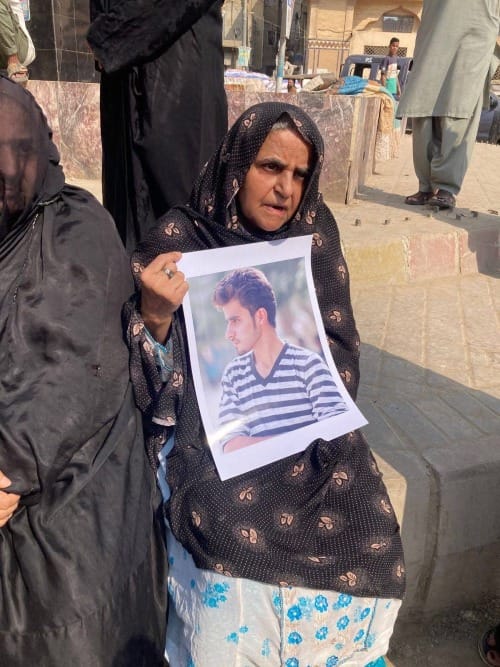
Jameela shares how she was never someone to step outside—she would always stay home, leaving errands and tasks to her daughters. “I didn’t even like being in photographs, not even on special occasions,” she admits. “But for Hamdan, everyone wanted to photograph me, and I let them. What remains of him without him? Nothing.”
A Broader Systemic Issue
Balochistan has long been gripped by a nationalist insurgency against the Pakistani state, rooted in its forceful annexation in 1948. Since then, repeated uprisings have demanded autonomy or independence. Fearing a resurgence and the idea of a unified Balochistan, the state has tightened its grip through heavy militarisation. This has led to widespread human rights abuses—where even suspected links to insurgents can result in arbitrary arrests, torture, enforced disappearances, and extrajudicial killings as part of a brutal counterinsurgency campaign.
This pattern of violence is tragically reflected in the cases of individuals like Balach Mola Bakhsh and Hamdan Baloch, both victims of custodial killings under similar circumstances. Balach, 24, was forcibly disappeared from his home in Turbat, Balochistan, on 29 October 2023.
After days of uncertainty, his arrest was acknowledged in a fabricated case, with the CTD accusing him of possessing explosives and having ties to an armed organization. On 21 November, he was sent to physical remand by a local court in Turbat.
Just two days after his court appearance, Balach was killed in a ‘staged encounter’ on the outskirts of Turbat while still in CTD custody on 23 November 2023, which led to widespread anger and protest in Balochistan. Later, a long march led by BYC to the capital city, Islamabad, against enforced disappearances and extrajudicial killings of Baloch by State forces.
Dr. Sabiha Baloch, the central leader of Baloch Yakjehti Committee [BYC] believes that ‘fake encounters’ are a form of collective punishment, designed with specific objectives in mind.
She explains that the practice of collective punishment serves two purposes.
“First, it aims to instill fear among the masses to maintain control and the second reason is that the state seeks to conceal its security failures. By killing already detained individuals, it boosts its own morale and presents an image of strength, claiming it has not failed but rather eliminated militants."
Dr. Sabiha stresses the critical role of civil societies and political parties during such times. "Human rights organizations must actively collect evidence and submit it to the relevant bodies and civil societies must speak out and document these violations, while political parties should advocate for change, agitate for justice, and organize the people to challenge the existing system."
Well-known Pakistani journalist Sahar Baloch argues that Balochistan has long been governed through a security-first paradigm, overshadowing civilian political reconciliation. She states, "In the context of an insurgency, the military and intelligence apparatus exercise de facto dominance, while civilian courts have limited authority over covert or intelligence-led operations." She highlights, "Families often lack access to documentation proving prior detention. When individuals, allegedly 'missing,' later appear in police encounters, accountability mechanisms are weak because the state narrative frames the death as a counterterrorism 'success.'"
Baloch also points to the limitations of Pakistan’s accountability mechanisms, noting, "Judicial commissions, human rights bodies, and parliamentary oversight have historically lacked enforcement powers. There is restricted access to military or intelligence records and political constraints on challenging security agencies." She further explains, "As a result, even when courts question encounters that lead to killings, sustained prosecution rarely follows."
Across Balochistan, and among Baloch communities countless families continue to wait for sons and brothers who never returned home. Hamdan was one of them, until his family received his body instead of the son they had spent weeks searching for.
By Hazaran Rahim Dad & Amir Naeem
Member discussion