
Judge, Jury and Executioner: Guilty by public opinion
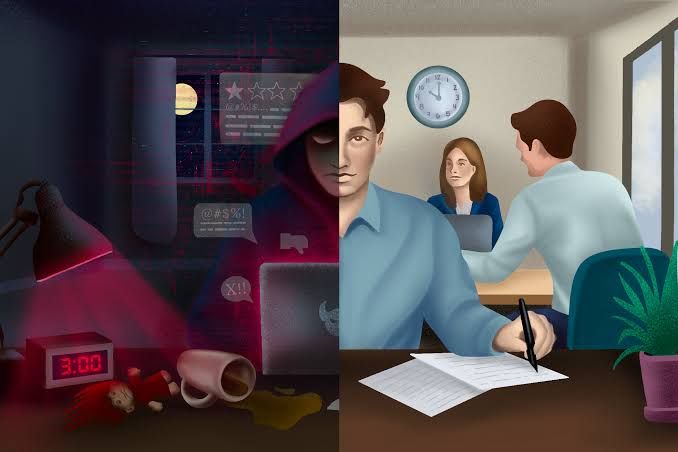
“People were sending me messages telling me to die,” said makeup artist Babar Zaheer while speaking with Muhammad Fahad Abid on his podcast about the bullying and harassment he faced when actor Mahira Khan was accused of getting Botox during her film Neelofar press tour.
“People will always talk; that’s their job, but the intensity of it can be damaging,” he said, noting how it impacted his mental health.
It was only an actor’s changed look, yet it enraged social media users so much that they wanted the man behind it dead. Zaheer’s incident is not an isolated one. Every day on social media, you see someone being trolled, bullied, called out over something as insignificant as a look or a statement, harassed and even cancelled over just one mistake.
At a time when social media has actually made raising legitimate issues easier, it has also made people become judge, jury and executioners on their own. So, the question we need to ask ourselves is: Where does accountability end and online mob mentality begin?
When one mistake defines you
Emaan Shafique Khan, a psychologist with over three years of professional experience in clinical psychology, explained this behaviour through the lens of the Fundamental Attribution Error. This is when we blame a person’s behaviour on their personality rather than considering the situation or circumstances they are in.
“When others make mistakes, we associate their behaviour with their personality or character. But when it comes to our own mistakes, we say, ‘I did that because I was stressed.’ We are lenient with ourselves, but we judge others immediately,” she said.
“If I call someone out... it indirectly means, ‘I am correct, which is why I am calling you out.’ There is this sort of feeling of superiority,” she added.
That sense of righteousness is not unusual in mob behaviour. Writing about online mobs for RICE Media, Ivan K. Wu argues that mobs typically believe they are fighting for a worthy cause, allowing group identity to overpower individual recognition of nuance and uncertainty.
Khan also pointed towards group conformity, where people join what a larger group is doing to fit in or feel a sense of belonging.
“We join in with whatever a large group is saying so that we feel a sense of belongingness and don't feel lonely, excluded, or abandoned,” she said.
Fundamental Attribution Error becomes particularly visible when repeated controversies begin defining someone’s entire online identity. Pakistani actor Alizeh Shah is one example.
Instead of being judged on her acting skills, Shah faced bullying for her clothing choices, appearances and choices in her personal life. Speaking with Dawn in 2022, she said people reacted negatively when she behaved differently in her personal life from the characters she played on television.
And eventually, years of memes, criticism of her appearance, her choice of projects and endless trolling eventually got to the actor and she announced her exit from the industry in 2025. She opened up about years of harassment, exploitation, media ridicule and online trolls on her Instagram account.
She said, "I'm going to expose every single person who did me wrong. I'm done with people trolling me, making fun of me, and making memes out of me. You guys have no idea how difficult an actor's life already is."
Why do we join the mob?
But does online trolling extend to celebrities only? It does not seem so. A senior recruiter working at a multinational company (MNC) told Echoes Media that her name appeared on rejection emails sent to applicants. After one candidate tagged her on LinkedIn, asking why their application had been rejected, others joined the discussion. Since it was an MNC, people from different countries also joined the conversation in the comments section.
It did not stop there. People began tagging her in posts and abusing her before eventually finding her personal Facebook and Instagram accounts and messaging her privately.
She described feeling anxious and exposed as she read the comments on LinkedIn and later received abusive messages on her personal social media accounts. She said that she had simply followed the company’s policy of informing applicants of rejections through a generic email and explained that the company did not provide individual reasons for rejecting internship or entry-level applications because it received thousands of applications.
The experience affected her so deeply that she did not go to the office for a week. The organisation later removed her name from rejection emails to prevent a similar incident from happening again.
“When we say, ‘these are trolls on the internet,’ we look at them as a separate community and call them trolls. But you don't need to look at them separately because... this online trolling community is a reflection of your society,” said Syed Faisal Karim.
Karim, a journalist and communication professional with more than 15 years of experience across broadcast journalism, news anchoring, media training, documentary production and strategic communication, also pointed towards another phenomenon: societal validation.
“As a journalist, it is your choice what story you want to do. And as a human, it is your right to choose what to talk about and what not to talk about,” he said. “This is called ‘societal validation,’ and it has become a huge part of our culture. In our common society, it has become a norm that you must speak on everything.”
Karim said he believes another part of the problem is that people react before verifying information.
“When even journalists are not verifying facts, how can an ordinary citizen be expected to fact-check? Why would a common person double-check? They will just follow suit.”
How a mob takes shape
Syed Hajib Hassan, a communications professional, explained another side of this behaviour through the Bandwagon Effect, where people join in because they see others doing the same, and Social Amplification of Risk, which explains how social media can make a controversy grow and attract widespread attention.
“From a media and communication perspective, the psychological concept that fits perfectly here is the ‘Bandwagon Effect.’ It explains why people join an existing wave of outrage. Another relevant theory is the ‘Social Amplification of Risk,’ which explains why social media can make controversies grow rapidly. When a controversy grows rapidly, it develops a ‘herd mentality’ where people stop thinking. In a mob mentality, people don't think; they just react.”
Evolutionary psychologist Nigel Barber, writing in Psychology Today, explains how anonymity can make members of a mob feel less individually responsible.
He calls this deindividuation, where a person’s attention shifts from themselves to the group, reducing their sense of individual responsibility.
But what about accountability?
On social media, likes, shares and reposts can amplify the opinions of others, allowing an opinion to quickly become a collective verdict. But accountability itself cannot be dismissed.
In recent years, we have seen an increase in celebrities and social media influencers calling for boycotts of certain brands, particularly since Israel’s genocide in Gaza started in 2023. While some celebrities boycotted these brands, others continued to endorse them, which eventually led sections of the public to turn against them and call for their cancellation.
In May 2024, Mahira Khan’s lifestyle brand, Mashion, faced criticism over a Mother’s Day promotional reel featuring Dove. Some social media users were furious over the collaboration because Dove’s parent company, Unilever, had faced boycott calls. Similarly, actor Maya Ali was also criticised for appearing in a Pepsi advertisement, while Hania Aamir faced backlash for promoting Garnier in June 2024.
Sharing his take on this issue, Hassan said, “Celebrities and Key Opinion Leaders are mega-influencers. They have an audience that is emotionally connected to them, and the masses have very legitimate expectations regarding their accountability.”
“Accountability is essential for society; otherwise, its direction will be completely disrupted,” he noted, but added that the issue becomes more complicated when celebrities are called out for their association with brands facing boycotts.
“A celebrity cannot be held responsible for everything a brand does globally, but they can be responsible for their decision to associate their name with that brand,” Hassan said.
“The real question is: what did they know, or what should they have reasonably known when they signed the deal?”
He explained that celebrities should perform due diligence before associating themselves with a brand. But once an agreement has already been signed, the situation is different. After signing, the celebrity's control becomes limited, and whether they can discontinue the relationship depends on the contractual terms.”
Back in 2022, Bollywood actor Akshay Kumar faced backlash for endorsing Vimal Elaichi, a brand associated with pan masala, despite his public image as a fitness enthusiast. Soon after the ad was aired, social media users started calling him out. Eventually, Kumar apologised and announced that he was stepping back from the endorsement and also pledged to donate his endorsement fee to charity.
However, the actor revealed that due to some contractual obligations, the brand could continue airing the advertisements until his contract legally expires.
This directly addresses the assumption that a celebrity can simply wake up and cancel an endorsement because social media demands it. At the same time, Hassan maintained that accountability is necessary: “The rule of thumb in a crisis is: if you did wrong and face backlash, accept it, apologize, and compensate.”
When the cause gets lost in the outrage
Most recently, American rapper Macklemore was removed from the remaining dates of Ed Sheeran's US tour after making pro-Palestinian statements during his performances. Sheeran later said the decision had been made by tour organisers after venues refused to host shows with Macklemore in the lineup.
For days, the conversation became about Macklemore, Sheeran, who supported whom and whether artists should take political positions. Yet the humanitarian crisis that prompted the controversy did not disappear when social media moved to its next argument.
Macklemore made it clear that he was “not a victim” and neither was “Ed Sheeran”. He pointed out that both had “careers, money, opportunities, safety and audiences around the world” and that, whatever consequences they faced for speaking out, they could still “go home to our families”.
“The victims are the Palestinian people,” he continued. “The men, women and children who have been killed, starved, displaced and forced to live through unimaginable violence. More than 20,000 children have been killed in Gaza alone. People are being killed today, and people will be killed tomorrow. I want to make sure that as I tell this story, we don’t lose sight of that.”
“If those words cost me the stage, while turning the conversation back to Palestine, then it was the most successful tour I’ve ever been on,” he added.
His statement showed how people often end up arguing over who is right or wrong instead of focusing on the crisis that started the conversation in the first place.
“This is called ‘societal validation,’ and it has become a huge part of our culture... it has become a norm that you must speak on everything,” Karim said.
But online outrage does not always remain online. Journalist Shahzeb Khanzada was heckled while shopping with his family abroad in November 2025. A man followed him and accused him of reporting against former prime minister and PTI founder Imran Khan and his wife Bushra Bibi. Khanzada did not engage and walked away.
Criticism is a major part of being a public figure, particularly a journalist, but does that give others the right to follow them when they are with their families?
Corporate lawyer Hamiz Khan, who has experience across private practice and the corporate sector, said there is a difference between criticism, defamation and harassment.
“If you are making factual statements based on evidence or backing, that is protected under the freedom of speech. You can speak against anyone, there is no issue,” Khan said.
“But when it goes toward defamation, that is different. Defamation and harassment are different concepts.”
“Both physical mobs and virtual mobs have long-lasting effects, one physical, the other psychological. We cannot say one is less harmful than the other,” he added.
After the internet moves on
Endorsing his comments, psychologist Khan said, “The victims, the content creators and celebrities who are attacked, can obviously develop symptoms of anxiety.
“They can face social difficulties, insomnia, and the constant dread of what comments will appear the next morning.”
Her concerns are also reflected in Pakistani research. A 2024 study by Muneeba Shakil, Faiza Batool, Amreen and Zainab Raheel, published in the Policy Journal of Social Science Review, studied 300 young adults in Pakistan and found cyber-harassment to be a significant predictor of depression, anxiety and stress, with the strongest relationship observed with depression.
“Someone who is severely harassed or threatened can even develop paranoid symptoms or hypervigilance... This persistent fear causes them to avoid going out, leading to social isolation. When you go into isolation, overthinking and anxiety are present, so you can obviously slide into depression,” Khan continued.
Amnesty International notes that freedom of expression is vital for holding the powerful to account. But freedom of expression and accountability do not require reducing a person to their worst moment.
Calling someone out is not the problem. Asking questions, criticising public actions and demanding accountability are necessary. The line is crossed when criticism stops being about what someone did and becomes a licence to humiliate, threaten or reduce them to that one act.
And perhaps, as psychologist Khan puts it, the problem is that “we are becoming inhuman while being human.”
“We are giving people less and less leverage to be human.”
Farheen Qureshi is a freelance journalist and communications professional with a background in digital journalism, editorial strategy and public relations.
Member discussion