
Archiving the Coast | Digital Activism on Karachi’s Coastline
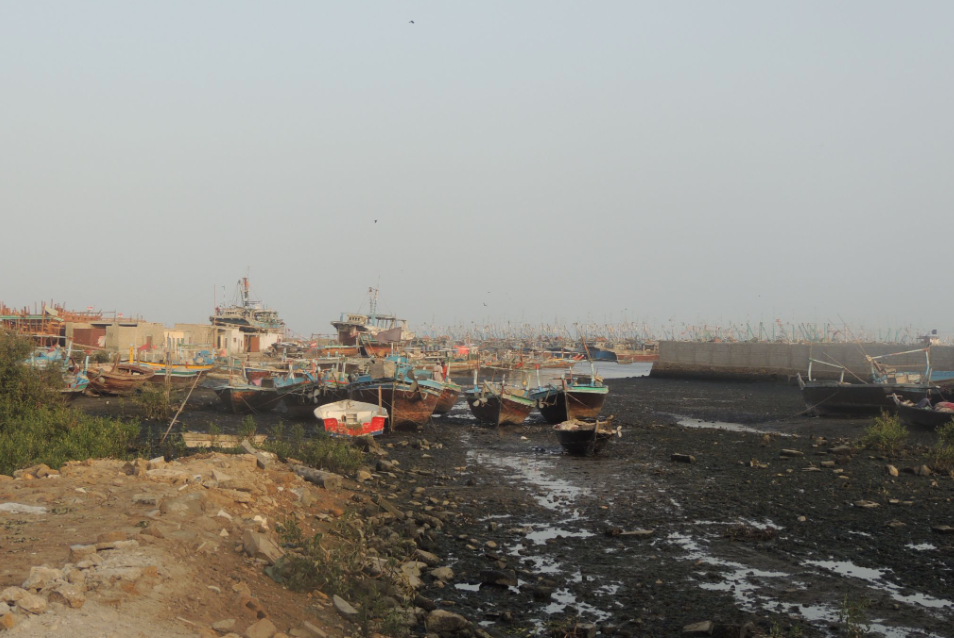
Stretching across 1,046 kilometers of coastline, Pakistan’s shore meets the Arabian Sea at an intersection of industrial encroachment, climate erosion, and state neglect. Along the edge of Karachi’s waters, local coastal communities are turning to digital platforms to archive local ecology, document indigenous knowledge, and defend their livelihoods.
In Rehri Goth, one of Karachi’s oldest fishing settlements, 23-year-old Almas Kasmani runs Saltwater Marine alongside eight young local volunteers. Their primary goal is to plant 10,000 native mangroves along the shoreline and convert Kasmani’s backyard nursery into an open classroom for local children and ecotourism. The project is rooted in a desire to rebuild a long-term relationship with the mangroves forest. Beyond serving as a habitat for diverse marine life, mangroves provide a critical protective shield for Karachi by absorbing the shock of ocean waves and storm surges. However, while the region’s marshes, fed by the Arabian Sea and freshwater from the Malir and Lyari rivers, once nurtured multiple mangrove varieties, the ecosystem has degraded to the point where primarily a single species survives: Avicennia marina (grey mangroves).
"Organisations showcase commitments on paper to preserve mangroves, but to hit their quota, they end up planting them in neat, straight lines," Kasmani explains. "That is the exact opposite of how a mangrove ecosystem naturally thrives", she shares while drawing up a star-like formation with her hand to guide us on the rigorous process of planting mangroves.
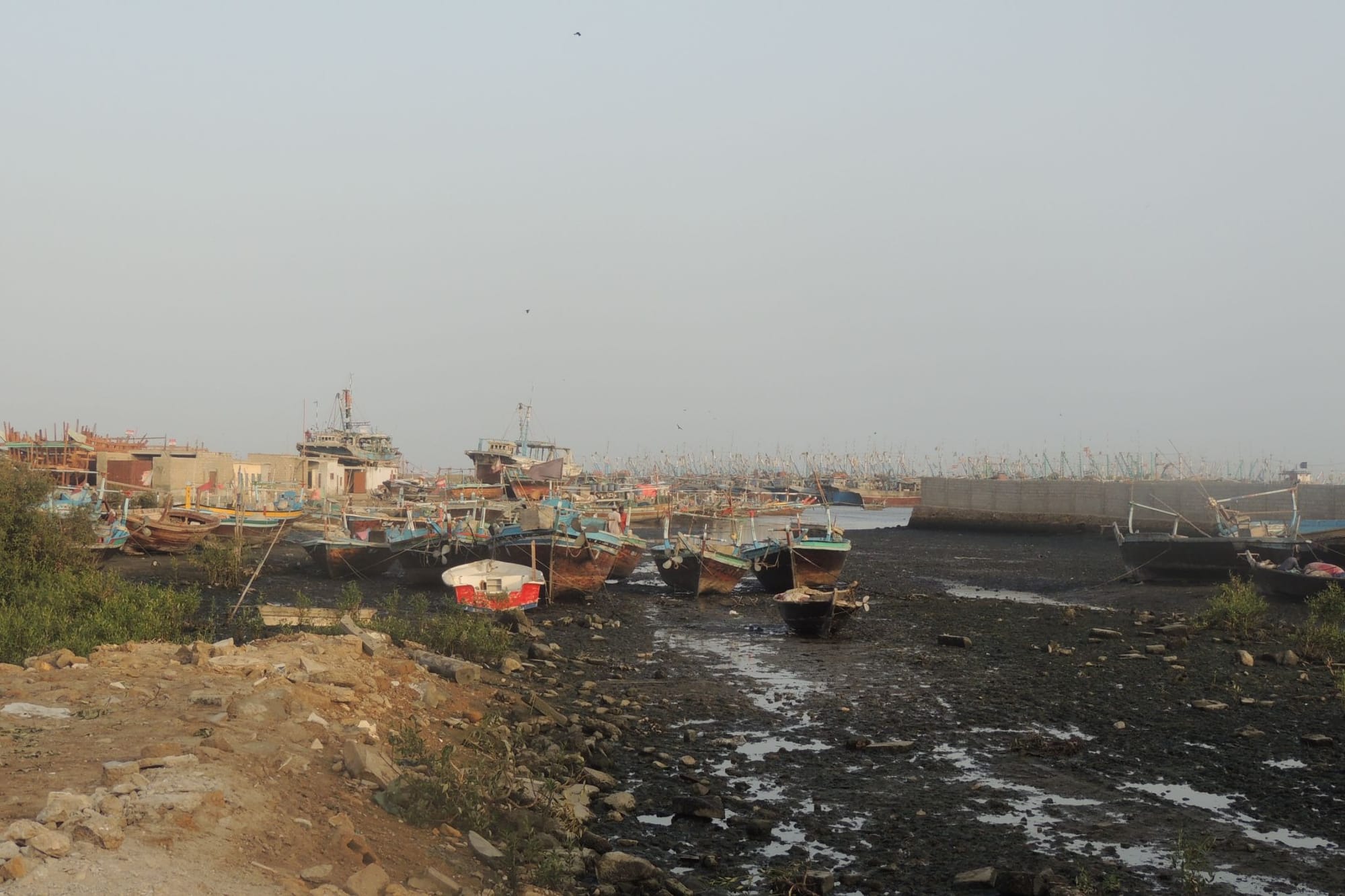
Coastline where the ships are docked surrounded by the industrial waste
Toxic corporate waste from industrial zones routinely pollutes these vital breeding grounds. To engage urban youth, Kasmani’s team hosts art drives that bring young people directly into the coastal mudflats, with a team of volunteers who undertake different roles ranging from plantation logistics and first aid to IT and creative development to ensure the smooth execution of their drives.
A graduate of a local Citizens Foundation (TCF) school, Kasmani was unable to pursue formal education past the tenth grade due to structural barriers. Rehri Goth remains severely under-resourced for a community of over 9,000 residents; its sole public school, run by TCF, has strict enrollment caps, and there are no higher education colleges in the locality. The area's primary healthcare facility contains just 36 beds and caters almost exclusively to immediate maternity care.
Despite these limitations, Kasmani leveraged her academic foundation from TCF and her lived experience along the coast to pursue independent environmental training.
She attended the Regional Seminar on Environmental Sustainability and Climate Action 2024 in Kathmandu, Nepal, and joined the People’s Biodiversity Register fellowship 2024 focused on mangrove restoration.
Both the experiences connected her to South and South East Asian climate activists whose commitment and custodianship towards their forests and mangroves inspired her with ideas. It led her to develop an archive of the local ecosystem through extensive interviews with community elders. During her research, she learned that Rehri Goth’s coast historically supported up to eight distinct mangrove varieties, 18 native bird species, over 92 marine species, and recurring dolphin sightings.
Driven to make this research accessible beyond community elders, Kasmani and her team began building a digital repository online. Even when a hardware failure wiped out her initial digital archive, the setback motivated her to expand the project's scope, where she and her team realised in order to take this information further it is important to bring people to the site by organising guided eco-tours. While algorithms often restrict Saltwater Marine’s social media reach to existing environmental circles, the team relies on interactive on-site activities and relevant Instagram content to broaden their viewership, ensuring the mangrove forest there does not share the same fate and neglect like Rehri Goth does.
Across the coastline on Karachi's western edge, Alina Mubashir encounters similar structural barriers through her work with The Mahi Project, an ocean literacy initiative based in Mubarak Village; a fishing community of over 10,000 residents located 30 kilometers from the city center.
As a delegate at the UN World Food Forum, Mubashir observed that international discussions often frame Pakistan exclusively through the lens of disaster and climate vulnerability. To emphasize local agency, she spearheaded a year-long pilot program in Mubarak Village focused on marine education in collaboration with the residents of the village. Partnering with CLAIM (Changing Learning to be Accessible, Inclusive, & Meaningful), she helped design a "blue school" curriculum to address the absence of ocean literacy in standard school systems.
Working directly with local youth and women, the curriculum is focused on using practical tools and digital learning to foster community-led solutions tailored to Mubarak Village's resources. However, severe infrastructure gaps persist: the village lacks basic internet connectivity and sits beyond military checkpoints, forcing residents to climb a nearby hill just to secure cellular service. While Mubashir aims to digitise the curriculum, limited connectivity forces her to rely on online platforms primarily for external fundraising and advocacy.
Where youth-led initiatives struggle against connectivity gaps, veteran community leaders use digital space to preserve historical memory. Seventy-two-year-old Abdul Majid Motani, a pioneer of the Pakistan Fisherfolk Forum, turned to social media after internal organisational shifts sidelined his physical advocacy work.
"I’m nothing without the knowledge of the ocean," Motani says. "I decided to take to Facebook to share everything I knew because I will not let my knowledge go to waste."
Encouraged by the late local historian Gul Hassan Kalmati, Motani regularly posts uncurated videos, photographs, and Urdu commentaries detailing coastal ecology, creek systems, tide patterns, and changing weather cycles. Though his audience consists largely of researchers, students, and fellow activists rather than policymakers, his archive serves as a crucial public record.
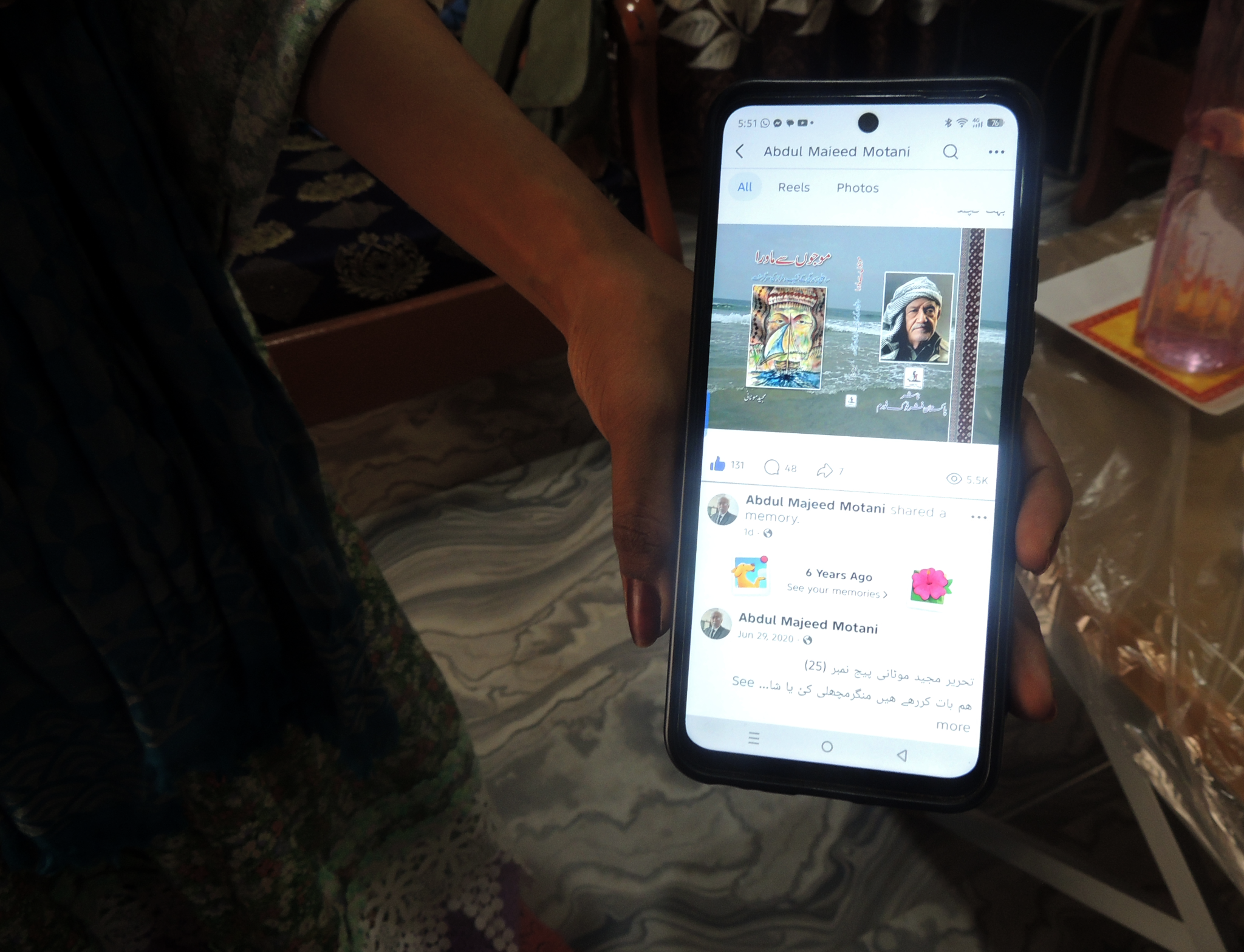
Abdul Majeed’s Facebook feed
Motani’s reliance on visual communication traces back to his youth. After being detained by Indian authorities for accidentally crossing maritime borders as a young fisherman, he later attended an international advocacy workshop. Despite initial language barriers, he realized that visual media allowed advocates across Asia to connect over shared ecological realities without needing a common spoken language. Today, social media serves as a natural digital extension of that visual approach.
Currently, encouraged by his daughter Fatima Majeed, Motani is compiling his online postings into a book on coastal history titled موجوں سے ماورا (Beyond the Waves). Together with cultural writer Ahmer Naqvi, Motani and Fatima Majeed also host educational boat tours for students and researchers, pairing ecological instruction with local culinary traditions. While youth engagement on platforms like Facebook has declined in recent years, these physical boat tours effectively bridge the gap between digital archives and younger generations.
Throughout Karachi, environmental activism faces continuous structural hurdles. In a city navigating economic strain, rising crime, and failing infrastructure, digital advocacy always risks falling into online echo chambers or passive "clicktivism." Yet, by pairing digital repositories with physical classrooms, restoration drives, and guided tours, advocates from Rehri Goth to Mubarak Village ensure that indigenous coastal knowledge remains active, documented, and firmly grounded in the communities that rely on it most.
__________________________________________________________________
This story was produced with the support of Asia Pacific Forum on Women, Law and Development (APWLD)’s Media Fellowship on Digitalisation and Feminist Digital Rights and Justice.
Beenish Sarfaraz is a researcher and writer from Karachi, Pakistan. She is currently pursuing her Master’s in Design and Care where she is interested in studying how systems of care can be supported through human-centered design interventions.
Member discussion