
Three Generations Of Baloch Women
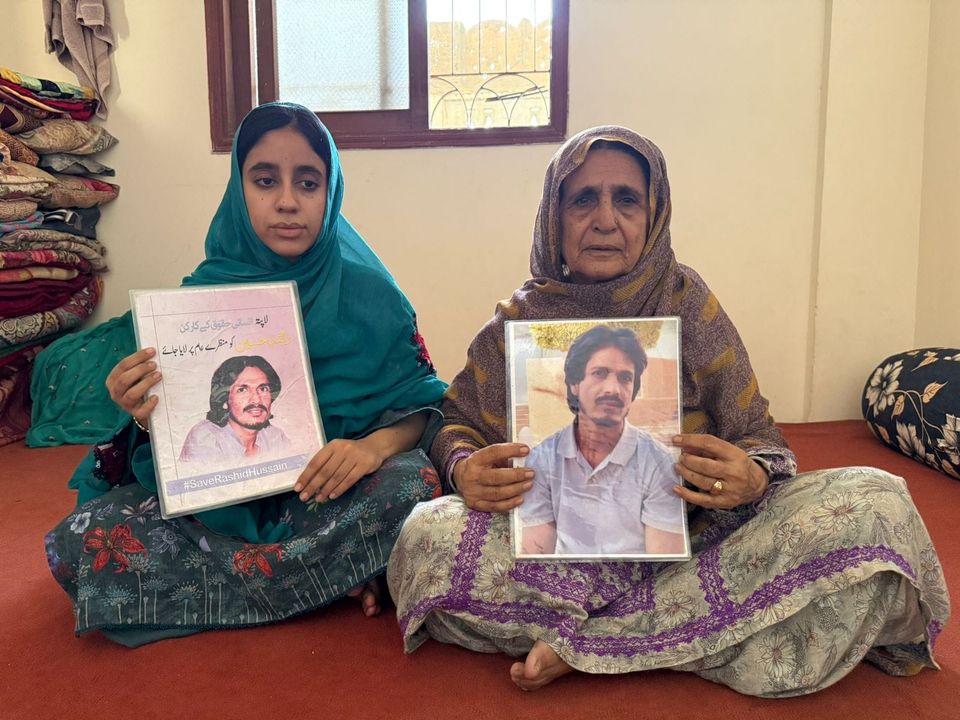
It was a seemingly normal afternoon in Hub Chowki, Balochistan, a city less than an hour away from Pakistan’s financial capital, Karachi, when Mahzaib Shafiq, now 18, was getting ready for madrassa, a religious school, on the lawn of her home. Her mother, Zahida Shafiq, was combing Mahzaib’s hair, her hands moving gently through her hair, the afternoon passing quietly.
Then came the news that changed her life.
Her grandmother, Baz Khatoon, walked in trembling.
She had received a phone call from the United Arab Emirates from her daughter, Fairda. Rashid Hussain, Baz Khatoon’s son, Zahida’s brother-in-law and Mahzaib’s uncle, had been taken away in Dubai.
Zahida's hand stopped in her daughter's hair. Mahzaib says she remembers standing up with all the strength her small body could gather, screaming, without fully understanding what had happened.
But to understand what that phone call meant, first you’d have to understand everything that came before it.
Baz Khatoon already knew the heaviness. She had already buried a son the same year. In February, she had lost Dil Jan, her son, who according to the family had joined the separatist group Baloch Liberation Army (BLA) and was killed during a clash with Pakistani security forces.
Scared of losing another son, in 2017 Baz Khatoon sent Hussain to Karachi to continue his studies after Dil Jan left for “the mountains”, a term used for those who join the insurgency. The family had sent Hussain to Dubai, believing that he would be safer there, even there he was not spared, she says.
According to the family, Hussain was detained by Dubai Police and Pakistani intelligence agencies earlier that morning, on December 25, 2018, around 9 a.m., and was later deported to Pakistan.
Hussain was traveling to work with his cousins in Dubai when they were intercepted by two vehicles. Officers of the Emirates security forces got off the vehicles, and questioned which one of them was Rashid Hussain. When he identified himself, he was dragged out of the car and taken away.
Hussain’s family claims that after six months of his detention he was deported to Pakistan without any legal procedure and since then, his whereabouts have remained unknown. The family has tried every legal channel, including courts and commissions, to know what happened to him.
In 2021, an anti-terrorism court named Rashid Hussain as one of the accused in a case related to the attack on the Chinese consulate in 2018 by the BLA. He was declared an absconder along with some others.
Baz Khatoon’s story traces back to the long-standing conflict of the Balochistan insurgency against Pakistan. Her family’s grief cannot be separated from that history.
Since 1948, when Balochistan became a part of Pakistan, separatists groups have fought government forces over greater political autonomy, over resources, and political autonomy.
Baloch people have long complained of rights abuses, political and economic marginalization, despite the region’s vast mineral wealth.
The resource-rich province has some of the lowest human development indicators in the region with 47% of the population living below the national poverty line, according to the latest national economic survey.
Running parallel to the insurgency is a well-documented and reported pattern of enforced disappearances. Anyone remotely suspected of links to separatist groups or being sympathetic to them is at the risk of being abducted, held without charge, and in many cases never returned. Rights groups have recorded these cases for decades.
According to Human Rights Council of Balochistan, an independent which started in 2016 and tracks the number of enforced disappearances on the ground and from Baloch media, 124 cases of enforced disappearances were recorded in the province in April this year.
Baloch Yakhjeti Committee, a grassroots rights organization, documented 752 new cases of enforced disappearance across the province in the first half of 2025 alone.
The government-initiated Commission of Inquiry on Enforced Disappearances, challenges the figures quoted by rights groups.
In 2020 the International Commission of Jurists said the commission has “wholly failed to address entrenched impunity, leaving victims and their loved without any redress.”
Families have marched, protested and campaigned for years.
When Baz Khatoon speaks of Rashid, her memory comes in gaps. She says she no longer remembers everything clearly — how she raised him, what he was like as a child, the small memories a mother usually carries.
She is originally from Anjeera, Zehri, in district Khuzdar, Balochistan — an area that is now considered one of the red zones of the conflict. For decades, this province — which makes up more than 40 percent of Pakistan's landmass, rich in natural resources yet home to its poorest people — has been the site of a grinding insurgency. Men are taken in broad daylight, sometimes by masked figures, thrown into black Vigos by what people there call the "known unknowns." Families are left without answers, without bodies, without endings.
Collective punishment: a family inside the war
Baz Khatoon's family has lived inside that war for a long time.
In 2007, she says her family was forced to leave Zehri and shift to Khuzdar.
The pressure began, according to the family, after Baz Khatoon’s sister Halima’s son, Basit Zehri, became part of the separatist group BLA in 2005. They had lived a settled life until then – her husband, Abdul Rasool, his brother, and Halima’s husband ran a steel firm, shops and orchards. A joint family sharing livelihood and loss.
Soon the loss outweighed everything else.
As in many cases of what is called "collective punishment," Basit's joining of the insurgency brought consequences for those who had not. His brother, Majeed — a high schooler at the time — was picked up.
Eight days later, Mahzaib’s father, Shafiq, received a phone call from the Pakistani intelligence agencies, instructing him to go to a remote forest area of Khuzdar and collect Majeed’s body.
The family searched the jungle and found him there.
Baz Khatoon still remembers the condition of the body. She says the nails on both his hands and feet were missing. Some of his teeth were gone. Some fingers had been brutally removed. There were cigarette-burn marks on his chest and signs of electric shocks on different parts of his body.
For Baz Khatoon, Majeed’s death was not an isolated tragedy. It was one of the first wounds in a long chain of loss.
Another tragedy fell on the family when it was gathered at their home, drinking their evening tea, the kind of moment in a joint family when everyone comes together after the day’s work.
When gunshots were heard at the gate, the women rushed to shield them with bodies. The family alleges state-backed death squads, private militias accused of working with security forces and terrorizing locals, were behind the incident.
No one was harmed but threats started pouring in. A few days later, the family received handwritten chits warning them to leave Khuzdar or face the consequences.
If a family member joins the insurgency, threats continue following the family and so the same fate befell Baz Khatoon’s family. On the eve of her nephew Hayee's engagement, the family was once again attacked by death squads who opened fire around midnight, the family says.
The next morning, the family says, the same death squads set fire to their steel firm, next to their home.
Halima’s son, Hafeez, was inside the office at the time. The family managed to save him, but the firm was reduced to ashes.
Two of the family’s orchards and their shops were also set on fire.
Following the series of attacks on the family, Dil Jan too joined the BLA in 2010. And so the violence and cascade of collective punishment of the family continued.
On February 2, 2012, Halima’s husband, Mohammad Ramzan Zehri, was allegedly gunned down by death squads when he was taking ration for workers at their farm.
Later that same year, Halima’s son Hayee also joined BLA. He was killed in a clash with forces on November 8, 2012.
By then, the family had begun to scatter. Some members left for Karachi. Some shifted elsewhere in Hub Chowki, others went to the UAE. Leaving Khuzdar, however, did not mean leaving the conflict behind.
In the same period, Abdul Rasool’s nephew, Habib, was closing his shop in Hub Chowki, when some men in plain clothes approached him. According to the family, they asked him to open the shutter, saying they wanted to buy something. As he bent down to lift it, he was shot dead.
The family says Habib was killed by state-backed death squads. His body was then dragged into the shop, and a Pakistani flag was draped over him.
The violence followed the family even outside Pakistan.
In the UAE, another of Halima’s sons, Abdul Hafeez, 37, was apprehended by Emirati authorities outside his home on January 27, 2022 and forcibly deported to Pakistan, and later released. The family says that on the very day of his release, he survived an attempted target killing.
Halima’s son-in-law, Abdul Hameed was also taken and later released.
Zahida, Mahzaib’s mother, remembers the day the family left Khuzdar.
She says the neighbours gathered around them as the family prepared to leave. Some placed the Quran on their heads. Others cried and embraced them. It was a farewell heavy with fear, grief and helplessness.
“It was hard, very hard,” she says.
But there was nothing left for them there then, and, she says, there is nothing left for her now either.
Even today, the thought of Khuzdar remains unbearable for her, she says.
Zahida says that if she has to travel to Quetta and the vehicle passes through Khuzdar, she closes her eyes as soon as the city approaches. Most vehicles stop at the main Khuzdar Bazaar for a break, but she remains inside, eyes shut.
“I do not want to see Khuzdar at all,” she says. “I feel the smell of Khuzdar, and the blood of all my beloved ones begins to appear before me.”
The toll of sleeping pills and antidepressants is visible on her body. She does not speak much. Between pauses, drowsy and heavy with sleep, she remembers fragments of a life that has been repeatedly uprooted.
For Zahida, Khuzdar is no longer simply a place. It is a landscape of memory — of burned shops, dead relatives, forced departures and unfinished mourning.
She says that after Habib was killed, Mahzaib’s father, Shafiq, also faced repeated targeted attempts by death squads. She does not remember the exact dates, but recalls that he was once shot and admitted to a hospital in Karachi for nearly a month.
According to Zahida, Shafiq’s name is also now in the Fourth Schedule – a list of “proscribed persons” suspected of involvement in terrorism, sectarian violence, or extremist activities.She says he has not been mentally well since the repeated attempts on his life. Shafiq was also recently enforcedly disappeared on 17 Dec 2025 and later released a week later.
After 2014, Shafiq also went to the UAE. But there, Zahida says, he was put on a blacklist by the Pakistani state. His visa was rejected, and he eventually returned to Hub.
Three generations of women now live under one roof with Mahzaib’s father. But much of the house, Zahida says, is handled by Mahzaib herself — a young woman who has had to grow older than her age.
Mahzaib is now 18. Every Monday, she has to appear before the CTD office in Hub. According to the family, she has been placed in the Fourth Schedule and faces multiple FIRs because of her protests in Hub for the safe release of her uncle — her mama — Rashid Hussain.
Resistance and Suppression
Baz Khatoon says she has lost almost every will she once had — her strength, her memory, even the certainty of whether Rashid is alive.
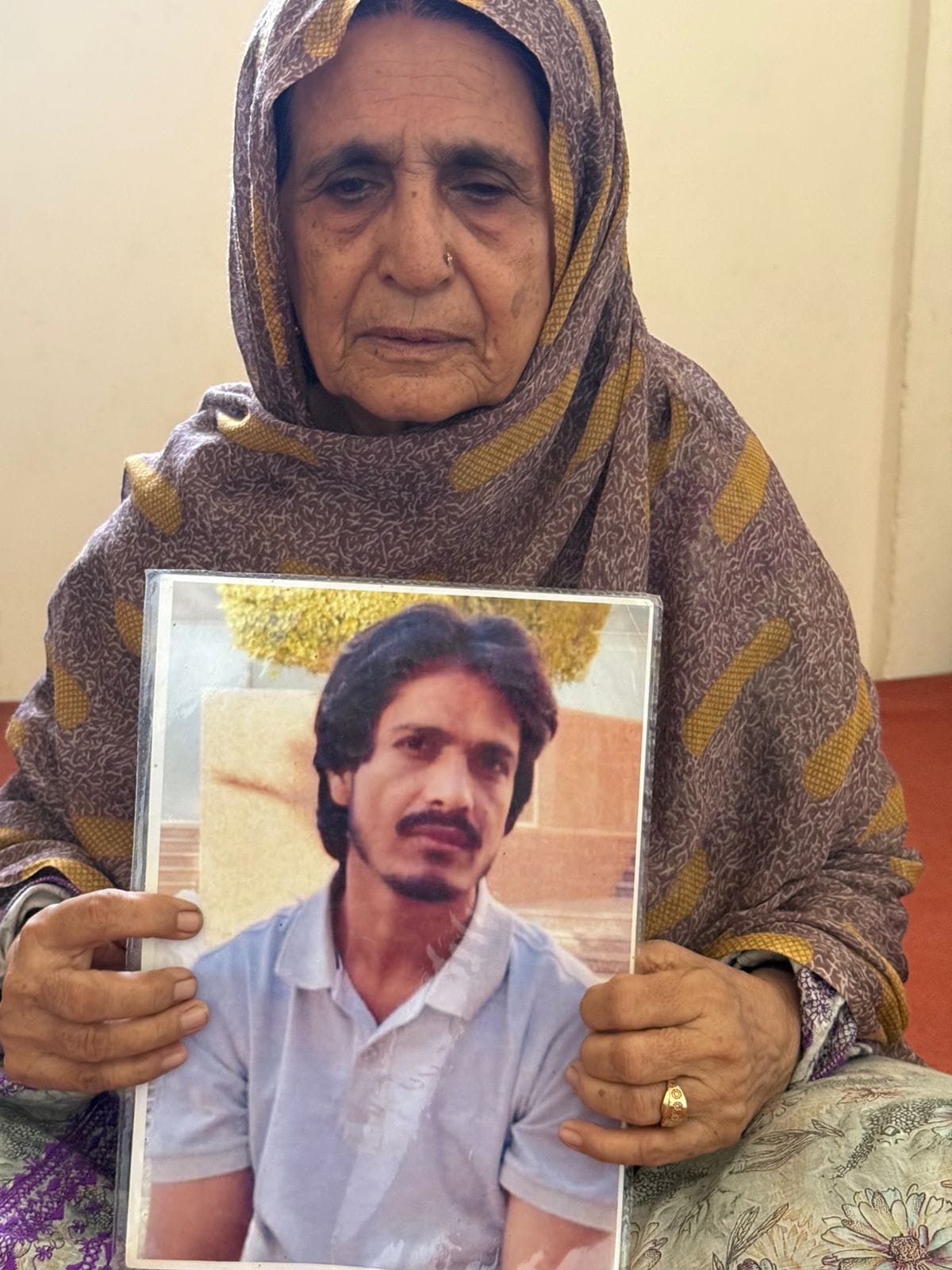
“All I know is that my memories with Rashid are gone after witnessing so many deaths of my loved ones,” she says. “All I carry now are the roads, and Rashid’s picture in my hands.”
For years, the roads became her only remaining space of resistance. Sitting in protest, holding Rashid’s photograph, gave her the feeling that she had not abandoned him.
“At least before, we had the roads,” she says. “It gave us one reason to believe that we had not forgotten our people. We were sitting for them, resisting in their memory. I was satisfied that I had not forgotten Rashid. I was doing something for him.”
But now, she says, even that space has been taken away.
“The government does not let us protest on the roads anymore,” she says.
Her grief has narrowed into one prayer.
“I have prayed to Allah that my soul is His amanat,” she says. “Do not take it away before I see Rashid. The day Rashid returns, once I see him even for a glance, take my life at that very moment — but not before I see him once.”
Then her worry turns to Mahzaib.
Mahzaib, she says, is still a child. Yet because she has protested for the safe recovery of her uncle Rashid, she has faced arrests, beatings, FIRs, court appearances and weekly visits to the CTD office.
“She went to ask for justice for her uncle,” Baz Khatoon says. “But now, at this age, she herself has been left at the mercy of justice.”
For Mahzaib, however, suppression has not broken her will. It has hardened it.
Born in a remote area of Zehri, displaced first to Khuzdar and then to Hub Chowki, Mahzaib says her life has been shaped by the search for Rashid. That search has taken her to protest camps, roads, courts and police offices across Pakistan.
But she says she no longer stands only for her uncle.
“I stand for all enforcedly disappeared persons,” Mahzaib says. “That is what Rashid Hussain has taught me.”
When she goes to a protest, she says, she does not want to carry only one poster.
“I want to be the voice of all.”
This story was produced with support from the Asia Pacific Forum on Women, Law and Development’s Feminist Media Fund for Alumni.
By Hazaran Rahim Dad and Somaiyah Hafeez
Member discussion